“Kiev is one of the few European cities where the European Union is synonymous with good government and the rule of law.”
Virtually all of Ukraine’s established politicians have discredited themselves: the protesters have no clear champion – one reason the violence may prove difficult to stop;
《Europe’s new battlefield》
Ukraine’s elites understood independence as right to pillage their country;
compounding the problem: Russian-speaking, industrialized east of the country and Crimea, and the nationalist-minded western Ukraine – the core of the protesters;
an issue of a free-trade agreement with the EU or a customs union with Russia suddenly becomes an existential choice between a corrupt and authoritarian post-Soviet system of governance and a European one;
Russia has long coveted Crimea.
《How to make the world $600 billion poorer》
Mr Obama now appears to be surrendering to protectionists within his own party
Congress must approve the trade agreements, however, a fast-track vote before November seems unlikely;
Tea Party Republicans: loth to grant Mr Obama the authority to do anything;
Democrats: the idea that they will not do much to help the economy; brand themselves as the anti-inequality party;
Mr Obama could have explained more … mentioning that cheap imports help reduce inequality of consumption;
“America cannot turn inward,” the Obama of 2008 said in Berlin. The Obama of 2014 is now responding:” Yes we can.”
《Taking aim at imports》
America’s continent-spanning economy is more self-contained than many people realize – imports and exports amounts to 23% of GDP, compared with 26% for the EU or 46% for China;
last time was in 2002, even so, 183 Democrats voting no, and moreover, the deal was small;
Compared to mid-1990s NAFTA, the level of scepticism is probably higher – citing NAFTA as the lessons;
Opponents requires more policy-making transparency – 1,150 meetings on the Asia deal alone is apparently insufficient;
a large group that likes the trade in theory but not in practice – “recent presidents have seized Congress’s constitutional trade authority” and ask for it to be returned;
It is hard to oppose greater transparency without sounding sinister.
《The politics of little bricks》
fits the old stereotype of Hollywood peddling anti-capitalist propaganda to kids, but hold on, the film is also an hour-and-a-half-long commercial for costly toys made by a multinational, a commercial that people must pay to see;
《Bridging the fiscal chasm》
at the end of 2013, liabilities of local governments: $1.8 trillion, one third of China’s GDP;
Guizhou, biggest fiscal chasm, liabilities 80% of its GDP;
some of the backing is implicit: if these guarantees are booked at their expected cost, Gansu’s debt burden falls from 44% to 19% of GDP;
debts look heavy compared with taxes: Yunnan and Qinghai, 260% and 370% of their budget revenues; however, China’s provinces do not have to rely on revenues, other funds – transferred from central government, land sales;
《Getting the messages》
Two profound trends that are transforming the technology landscape: rapid growth of web-connected smartphones and dramatic decline in the cost of building start-ups;
《Here, there and everywhere》
Dutch advantage: balance power between management, the board and shareholders, no meeting required to approve resolutions, few requirements on compensation – Europe’s Delaware; ability to issue “loyalty” shares;
Embraced Washington consensus in the 1990s but the crunch in 2001 left it permanently suspicious of liberal reform
Argentina’s decline has been largely self-inflicted: protectionism, prefer quick-fix rather than thorough reform of the country’s schools
《A century of decline》
Three deep-lying explanations:
Rich but not modern 100 years ago: low literacy rates, lowest secondary-school attendance;
Being out of sync with the rest of the world, trading policy: the divide between farmers and workers;
Not evolving political apparatus, short-termism;
《The petrostate of America》
Franking: should have added 2-4% to American GDP;
Oil boom, owed less to geological luck than enterprise, ready finance, and dazzling technology;
Foreign policy might not change, but energy policy should: lift the oil export ban, getting permits of gas export more easily; generating cash to pay foreign policy dividends; also might cause domestic gas prices to rise a little;
《Saudi America》
Turn America into a swing producer; make both dollar and the economy less sensitive to oil prices;
Back to stabilizing role it played in the 1960s;
Crude-oil could start more or less straight away; but the political debate is only in its infancy;
《TV star》
Advocating of consolidation: more power to negotiate with content companies; margins only 50% compared to broadband 100%;
Financial discipline, better control cost than conventional Hollywood boss;
“Not the best at innovating, but the best at scaling others’ innovations”
《Fixing forward guidance》
Specific threshold of Fed and BoE: 6.5% and 7%; they are muddying them now;
Fed downplayed; BoE scrapped the unemployment threshold – a clearer message;
《Closing the gap》
Gap between actual and potential output, hard to discern; three different indicators tell different stories;
《The growth paradox》
No link between economy growth per capita and stock market returns: “value” effect; stock market not a perfect representation of the domestic economy (real dividend growth more slowly than the economy);
《No profits, we promise》
JD is pursuing an “asset-heavy” model that puts scale and market-share above short-term profits;
Two big questions: logistic infrastructure and local rivals (Tencent and Alibaba)
《A number of great import》
Current account surplus narrowed to only 2% of GDP last year; but by far the largest services deficit in the world (already helped by less competitive yuan, which rose over 7% last year);
The worst-hits have been those with specific problems
As money flows back to US, let exchange rate slide and risk inflation, or increase interest rates and risk a recession?
No sign of problems in corporate results yet
Equities look expensive, positive for government bonds
《My country is right or righter》
NHK seek to follow the government’s line
For Abe and LDP, rebooting the media is a strategic priority
Pacifism still remains popular at home
《Search over》
How link works: Google Shopping scored 36.7% of clicks, against 5% for rivals;
Now it will show links to rivals alongside;
《News you can lose》
CNN: no glory in the role of unbiased “referee” between partisan networks (left-leaning MSNBC, and conservative Fox News); “Nobody goes to the game to see the ref.”
More people turning to the internet: “there is a ‘ceiling’ to how many people are getting their news from television today.”
what works today is entertainment;
CNN’s costs are also high: it has more bureaus than MSNBC and Fox News; “in produce business,” “News comes and goes so quickly.”
《Countervailing motion》
Fed’s shift to less expansionary monetary policy is only half the story: Central bank in Euro area and Japan are still moving in the opposite direction – “not conducting synchronized tightening”;
“If Japan is confronting the ghost of deflation past, the euro zone is spooked by deflation yet to come.”
BOJ started asset purchase $70bn a month, far greater relative to Japan’s economy – pushed up headline inflation to 1.6%, with core inflation (energy and food) entering into positive territory and rising at fastest pace since 1998;
Abe’s resuscitation plan – encourage hiring and raise wages;
Turmoil from EM: as global investors seek refuge in financial havens, the yen has started to appreciate again – make Abe nervous about raising the consumption tax;
Euro zone: core inflation only 0.8%, one notch up from the record low 0.7% at the end of 2013;
《Down to 1.4 and 17》
20% of performance fees and 2% of management fees down to 17% and 1.4%;
Hedge funds as a whole undershot just about any benchmark in recent years;
Another factor: rush of new investors (pension funds, endowments, sovereign funds), greater negotiating power
Good year: protests seen off; Syria; NATO frustrating in Afghanistan;
Ukraine matters much to Putin
《Sochi or Bust》
Most expensive in history – corruption, inefficiencies;
Tight security;
As vulnerable as 1980s: oil & gas rent – use them to consolidate power; problem is excess of money and lack institutions; repression or democratization? Widespread dissatisfaction and discontent among elites.
《Too Big to Fail, But in a Good Way》
Koc and Sabanci: more than a quarter of Turkish market cap;
Short positions in FX provide hedge;
Untrammeled access to a market in EU;
Despite of conglomerate discount, global indexes prefer to own holding company;
Resist the vanity of owning news media and out of public facilities, governments have left them to get on with doing business – “long may that continue.”
《Deal or No Deal?》
Polarization of two parties, obama’s promise to bypass legislature – things are getting better;
Several deals are possible: minimum wage vs income tax credit; immigration; promoting free trade.
《The Odd Couple》
New Komeito and LDP – relations hit a low point:
Conflict in Yasukuni shrine;
Self defense constitution;
Nuclear reactors;
China policy;
Economy
Votes: bind this odd couple together – 8m members of Buddhist, Soka Gakkai.
《Physician, Heal Thyself》
A system that inflates the cost of medicine;
Public hospital is actually not public, doctor underpaid & higher than OECD spending on medicine;
Kickbacks account for more than 20% of final retail price
Promoting generic brands is difficult in China – Provincial bidding system, squeezes margins of drug companies, they would rather not make or supply the drugs
《Less Amazing than Amazon》
Walmart New CEO, an inflection point: open more smaller stores, step up its counterattack on Amazon – But it is chasing a fast-moving target;
Aims to – build up the market ecosystem that pulls together shops, warehouses, delivery, fleets, and technology.
《Fixing a Flat》
The departure of Lanxess CEO
One quarter of revenues from types and auto parts;
Oversupply when doing well causes fall in prices;
It needs a disciplined manager to cut costs (New CEO from Merck);
One solution: produce abroad or keep pushing those high-end products
《Don’t Panic》
Most EM are far less vulnerable than they were in 1997.
Risk factors: rising rates in America; slower growth in China.
Policy makers used market turmoil to push through more reform;
Yet not wholly in control, the flow of capital has more to do with what happens beyond their borders.
《Locus of Extremity》
Rising rate impact on the Fragile Five: reducing demand for EM assets;
As group, EM actually net exporters of capital: smoked the foreign currency but did not inhale, while some of them breath deep
Countermeasures: ban imports, taxed luxuries, let currencies fall;
Anticipating a more normal world – pension funds can meet their obligations and investors more reluctant to venture into anything exciting abroad.
《The Coin Has Two Faces》
Currency traders have had little to get their teeth into;
Policy dampens fluctuations;
Long term investors shifted to dollar buyers;
Last period of dollar strength was late 1990s – Internet booms, now linked to potential of shale gas;
Negative consequence: EM struggled to peg, difficult for American exporters, and for commodity importers;
Good news: US bonds more attractive
《The Price of Getting Back to Work》
America recovered quickly but lower in employment rate, reversed trends in UK;
Productivity puzzle:
Falling productivity cushioned against job losses in recession, while resulted in high inflation;
Declining productivity is consequence of falling real wages: lower real wages encouraged firms to use more labors and less capital, causing productivity to fall but popping up employment;
In US, milder inflation, discourages hiring, leading to rising productivity and weak employment growth.
Improve governance – Chinese consumers more active;
Respond to local tastes.
《Doing It Their Way》
World shaped by china’s rush to consumerism:
stated goal;
increasing in absolute terms;
urbanization;
Sophisticated markets:
skewed to expensive;
online from the start: heavily reliance on peer reviews
brand switching: first – mover becomes old-fashioned;
go abroad;
creative marketing and advertising.
《In Three Parts》
Chinese economy: three forms of growth – supply, demand, and credit;
Supply: demographic turning point;
Demand: Not overheating;
Credit: in three categories: (1) adds to both supply and demand; (2) add nothing to capacity but to demand; (3) adds little to economic growth;
Chinese pattern of investment remains a worry, but at least enjoys a re-balancing of incomes and production, also the shift in production – more in services than industry.
《Patch-up Job》
Internets giants engage in breathtaking tax gymnastics:
France: buzzing with Internet-tax proposals; culture tax;
Italy, pass law to curb profit-shifting;
Chile: tech giants’ clients are in taxman’s crosshairs.
《Grease-Proof Taper》
Fragile five – BRL, INR, IDR, ZAR, TRY; Brazil most overheated, while Turkey and South Africa are running more current-account deficits, and much smaller FX reserves;
In 2014, demand commodities likely to remain restrained, affecting AUD and CAD.
《Fighting the system》
Lionsgate: lean, bolder, freer to pursue opportunities, keep looking for new franchises.
不知与情人节有什么关联,BAM Rose在这两个星期将会颁出一个名为“Vengeance is Hers”的系列,长达十部作品,以荧幕上(某一种)令人过目难忘的女角色为主线串成——女性在复仇。以下是BAM网站上的简介:
From screwball proto-feminism to witchy gothic horror to cerebral auteurist classics, this series gathers some of cinema’s most unforgettable heroines and anti-heroines as they seize control and take no prisoners.
回到电影本身,本周令人关注的有二:芬兰导演阿基·考里斯马基《火柴厂女工》(1990, 68min, 7.7, 8.3)和日本导演新藤兼人《黑猫》(1968, 99min, 7.8, 7.8)。尤其前者,是数得上的芬兰电影佳作,在两个月前林肯中心“Ozu and His Aftelives”的系列里,该片也曾被挑选出来放映过。
Film Forum 是新浪潮“左岸”与“手册”两派的主战场。本周的前四天,戈达尔柏林金熊奖作品《阿尔法城》(1965, 99min, 7.3, 7.5)压阵,而阿伦·雷奈的《我爱你,我爱你》(1968, 91min, 7.5, 7.3)将在周五情人节上映迎头赶上。这两部作品大致都处在“新浪潮”晚期(甚至都不归属于“新浪潮”),两位导演的的风格也相继定型——必然少了早期时候的张扬和锋芒,但是对自身电影语言的信心和坚持,显然是更多了。网站上对《阿尔法城》如此介绍:
Godard creates an eerie sense of sci-fi alienation with striking b&w shooting — sans artificial light — by the great Raoul Coutard on the all-location-shot wintry streets of Paris ’65.
Viewed in Metropolitan Museum of Art, New York in Fall 2013.
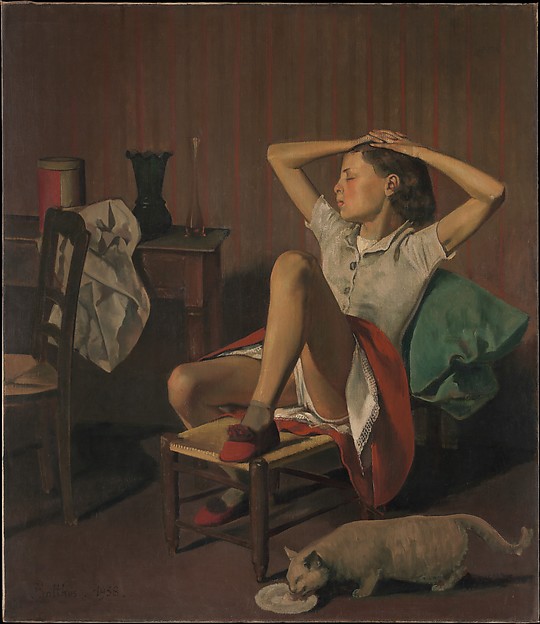
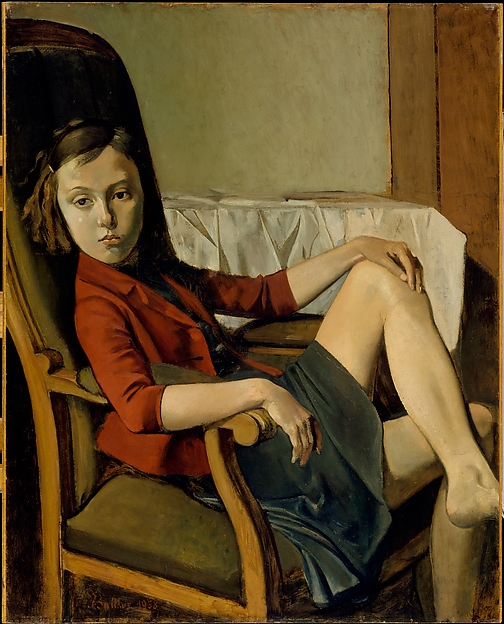
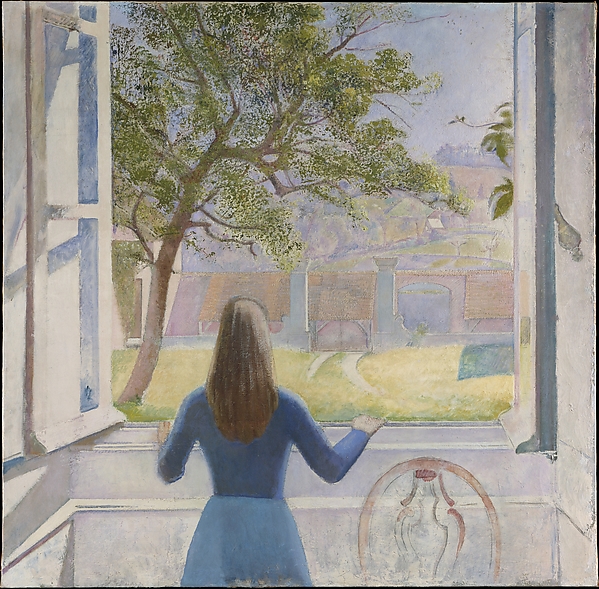
Balthus (Balthasar Klossowski). Brother and Sister (Hubert and Thérèse Blanchard), 1936Balthus (Balthasar Klossowski) . Thérèse Dreaming, 1938Balthus (Balthasar Klossowski) . Thérèse, 1938Balthus (Baltusz Klossowski). The Living Room, 1942Balthus (Baltusz Klossowski). The Golden Days, 1944-46Balthus (Balthasar Klossowski). Sleeping Girl, 1943Balthus (Balthasar Klossowski). Still Life with a Figure, 1940Balthus (Balthasar Klossowski). The Room, 1947-48Balthus (Balthasar Klossowski). Nude with Cat, 1949Balthus (Balthasar Klossowski). Girl at a Window, 1957Balthus (Balthasar Klossowski). Nude Before a Mirror, 1955
Based on museum audio guide. The number of each painting corresponds to the actual item number in the museum.
200. Time is a River without Bank
Marc Chagall. Time is a River without Bank, 1930-39
Up till now I still think of this painting by Chagall in his early period as the most poetic and romantic one in this exhibition. Perhaps this is also why the museum placed it at the front of the hall. In this painting, we see a wide and peaceful river which of course represents Chagall’s hometown; while the flying fish is his father. Chagall himself and his wife, Bella, which are the only two “live” figures in the picture, sit at the corner, holding each other and cherishing the moment being together. This painting is about time, memory and loss, as said by the commentary, which I cannot agree more. Time is like a river, which is always moving and never stops. The grandfather clock in the middle, which is a more obvious symbol of time, in my opinion, is more of a implication of the objectiveness about time and we as human beings have to sit aside to either embrace or withstand the memory and loss that the times brings to us.
201. The Lovers
Marc Chagall. The Lovers, 1937
To understand this painting, it is important to know that bouquet was rare in Russia but plenty in Paris back in 1930s. This helps us understand the inner passion and spiritual energy that drive Chagall to grow and grows his flowers to essentially the whole canvas. The background color of this image is similar to the last one, and also from the lower right-hand side we see the houses the sheep representing Chagall’s hometown and his nostalgia while living in Paris and enjoying his sweet life at the same time. The contrast between these two color palettes and the emotions behind them make this bouquet look so special and joyful.
Based on museum audio guide. The number of each painting corresponds to the actual item number in the museum.
651. The Lost Jockery
René Magritte. Le Jockery perdu (The Lost Jockery). Brussels, 1926
The black curtains on the sides of the canvas remind us what we see behind is actually something not real (even surreal?). In the center of the “stage”, we have Magritte (should be himself, right?) riding a horse, seems running very fast but looks like not going anywhere. The standing “trunks” is actually bilboquets – a French toy and Magritte repeatedly used this form in his early works.
652. Portrait of Paul Nouge
René Magritte. Portrait of Paul Nouge. 1927
Paul Nouge was a Belgian composer and he was a close friend of Magritte. In this painting Magritte challenged the convention view that portrait should be singular. The two Pauls look almost identical but with tiny differences – the shades of foreheads, one’s hand was cropped out of the canvas, etc. We believe from Magritte’s view, neither of them is Paul Nouge and both are representations.
653. The Secret Player
René Magritte. Le Joueur secret (The Secret Player). Brussels, 1927
Again, we see the curtain and bilboquets. But here in front of us is an even weird and surreal world, with two players and a woman in a closet whose size is smaller than usual. What is interesting about this work is – it seems there are two sources of light. Obviously one is coming from left to the right (you can tell from the reflection of the bilboquets) and the other one, which sheds light on the woman’s face, is less to be aware of. This is a painting without a narrative and we can only explore the meaning and the truth simply by looking at it.
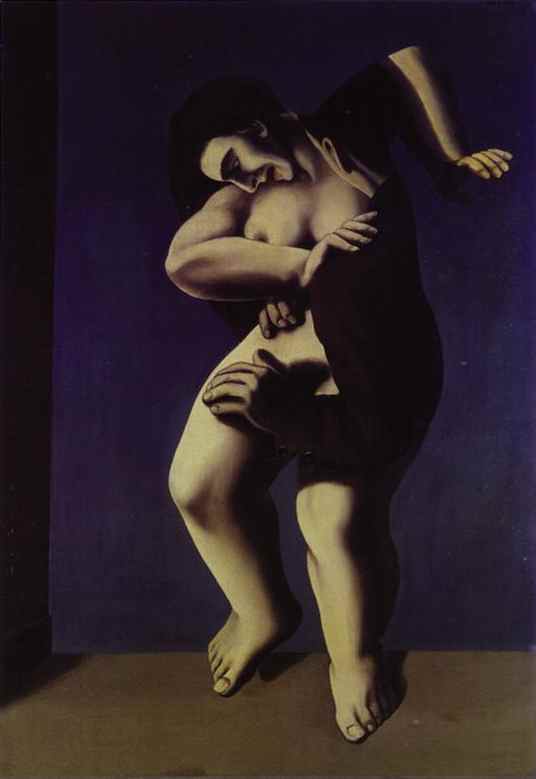
655. The Titanic Days
René Magritte. Les Jours gigantesques (The Titanic Days). Paris, 1928
This one is disturbing – not only because it shows a man fighting with a woman but more than that we see the two bodies are forced to be in one plane. The three-dimension conventional pictorial space is destroyed.
656. Attempting the Impossible
René Magritte. Tentative de I’impossible (Attempting the Impossible). Paris, 1928
Magritte and his wife. This can be regarded as the most literal interpretation of what a painter does – just apply paints – there is nothing more mystical, mysterious, and metaphysical about it. This also reflects the Surrealists’ attack on painting as a medium itself at the very beginning and what Magritte was trying to bring us here is the initial state of painting, without being commercialized, related to religion or something else, just paint. On another perspective, this painting also reminds us of Pygmalion, the Greek mythological character that brings his beloved sculpture to life.
657. The False Mirror
René Magritte. The False Mirror (Le Perreux-sur-Marne), 1928
Unfortunately this is the only one painting that I knew before I came to this exhibition (but not knowing it is from Magritte). The caption of this work makes us to think about, and problematize that optical vision is limited. What you see is not necessarily reality – inner vision, hallucination, and dream may provide us as real as what we see in external phenomena – this plays an important role in Surrealism and the relationships between dream and reality, vision and illusion, what we see and what we do not see, are among the central issues that the Surrealist painters wanted to address.
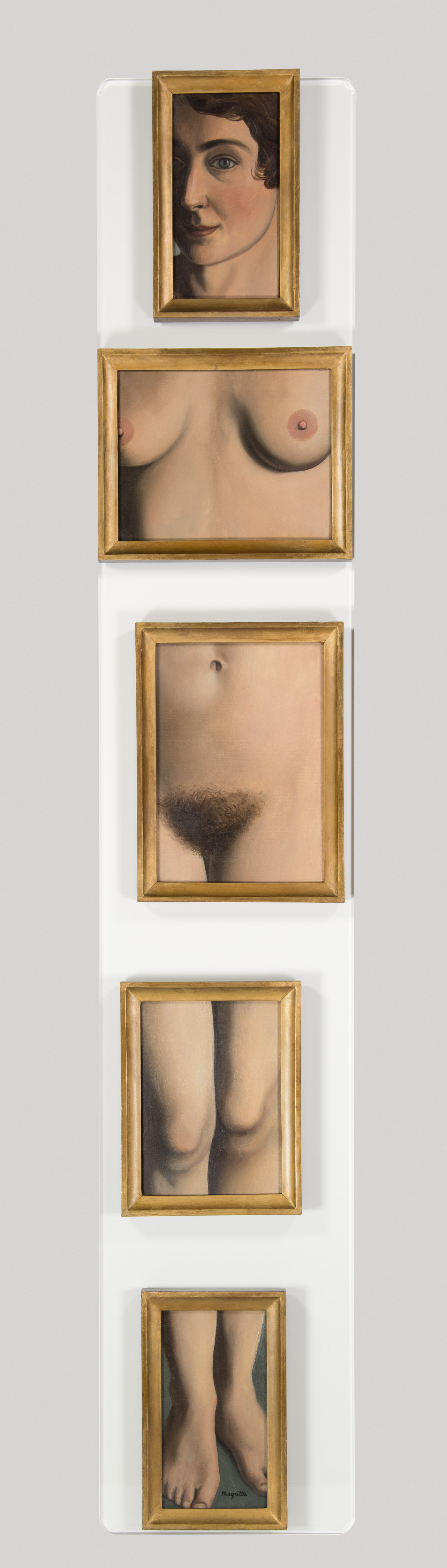
658. The Eternally Obvious
René Magritte. L’Evidence eternelle (The Eternally Obvious). Paris, 1930
Personally I think this is the most “magical” work in this exhibition and what you actually see is definitely beyond the five pieces of female torso. It simply ignites your imagination and brings about the inner desire to connect these disjoint pieces and even to create . Each individual piece may also represent a radical and violent act in terms of creation – the cropped and closeup view of a particular part of a female’s body – to some sense it looks like a photograph rather than a painting. It interestingly illustrates the relationship between these two and somewhat the fear that photography as mechanical reproduction is threatening the role of painting.
660. Elective Affinities
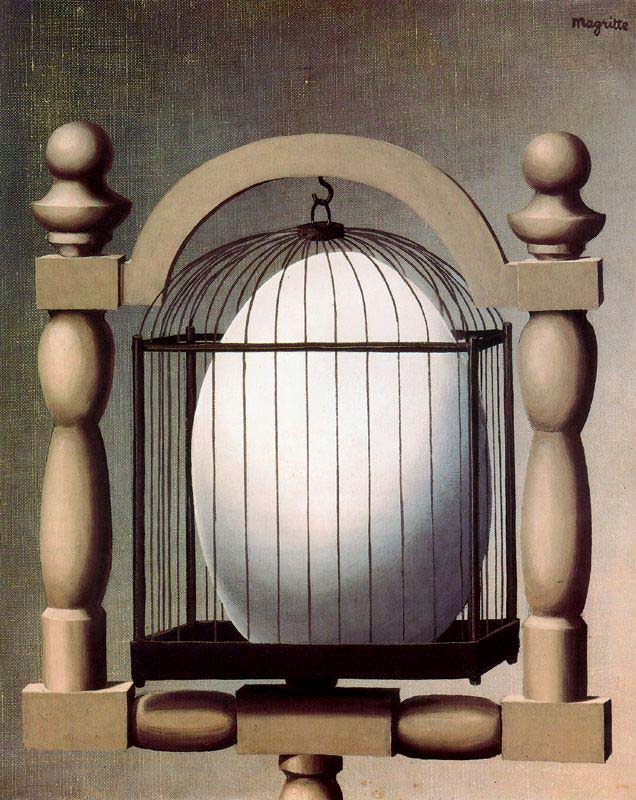
René Magritte. Les Affinites electives (Elective Affinities). Brussels, 1932
One of the several works that I cannot understand well. Magritte are trying to depict some form of illusion here because the positions of the edges of the cage are self-contradictory.
661. The Light of Coincidence
René Magritte. La Lumière des coincidences (The Light of Coincidence). Brussels, 1933
This one is my favorite since there are so many interpretations of its meaning, and the line between truth and illusion so blurred here. One cannot really tell if we are seeing a painted female torso in the frame, or instead a sculpture which is illuminated by the candle. The vivid light and shades of the torso is driving us to discover the truth and puzzling us at the same time, with the help the candle, which then represents illumination. Human is illuminated by arts, just like the torso is illuminated by the candle. This simple and complex work illustrates how paintings are created and how arts tell or do not tell stories and communicating ideas.
662. The Interpretation of Dreams
René Magritte. La Clef des songes (The Interpretation of Dreams), 1935
One interesting thing about this work is the English rather than French words under each of the objects (thought only the bottom right is correct). The mismatch between the objects and the meanings of the words reveals the complexity how we as a view gather information from a painting.
663. Clairvoyance
René Magritte. La Clairvoyance (Clairvoyance). Brussels, 1936
Magritte himself is present in this painting, illustrating what his daily work looks like and what he thinks about his work and art itself. Painting is about reproduction – it tells us the truth but also suggests multiplicity. There is no relationship between the egg and the bird and it is something else which is beyond the simply realistic and mechanical reproduction that connects this two objects together.
664. Not to Be Reproduced
René Magritte. La Reproduction interdite (Not to Be Reproduced). Brussels, 1937
The caption of this work is interesting – not to be reproduced. Perhaps this is why the figure behind the mirror refused to turn around his face to us? This hence poses the question on the role of painting as means of reproduction. The figure behind the mirror represents the hidden potential behind our everyday life. More often than not, life and truth is not about what we see but what it is concealed.
665. On the Threshold of Liberty
René Magritte. Au seuil de la liberte (On the Threshold of Liberty). London, 1937
It is hard to imagine what you will really feel if you walk into a room like this. This painting plays with our expectations. One thing to note is that the texture in each plane (for example, the female torso and the wood next to it) and Magritte has applied quite different techniques to achieve that.
林肯中心在岁末推出乔治·库克专场(名为“The Discreet Charm of George Cukor”,由布努埃尔的电影名《资产阶级的审慎魅力》而来,很有意思)。宣传手册上说,乔治不但是上个世纪中叶最成功的好莱坞导演,风格多样,他还一手捧红了包括格蕾塔·嘉宝,凯瑟琳·赫本,琼·克劳馥,朱迪·嘉兰等多名具有时代意义的女演员。现在这个系列已经过半,上述多位女星已悉数登场,本周为我们压阵的将是另外两位重量级人物:奥黛丽·赫本和英格丽·褒曼——《窈窕淑女》(1964, 170 min, 7.9, 7.8)和《煤气灯下》(1944, 114 min, 7.8, 8.0)。前者帮助乔治获得了他唯一一次奥斯卡最佳导演(当然这部电影也席卷了1965年奥斯卡的八个奖项),后者则是英格丽首度摘得奥斯卡影后的作品(其本人生涯共三次捧回小金人)。
附林肯中心对该系列的引言:
George Cukor was one of Hollywood’s most successful and versatile filmmakers: a master of the musical drama, the screwball comedy, the domestic thriller, and the literary adaptation—not to mention a legendary director of actresses, guiding the likes of Greta Garbo, Katharine Hepburn, Joan Crawford, and Judy Garland to career-defining performances.
Kubrick and author Arthur C. Clarke’s sci-fi masterwork does nothing less than trace the arc of civilization, from prehistoric prehumans to space-traveling astronauts in the then-future of the titular year. With its unconventional structure and groundbreaking imagery, 2001 proved polarizing upon release (its—and Kubrick’s—only Oscar was for the still-influential visual effects) but now widely ranks among the greatest of all films. On its 45th anniversary, this landmark head-trip remains as visionary and awe-inspiring as ever, demanding to be seen—and seen again—on the big screen.
Sat: La Collectionneuse (1:30); My Night at Maud’s (3:30); An Autumn Afternoon (4:00);
Sun: The Marriage of Maria Braun (4:00); Equinox Flower (6:45);
林肯中心“Ozu and His Afterlives”的主角将在周末登场——《秋刀鱼之味》(1962, 112min, 8.0, 8.7)和《彼岸花》(1958, 118min, 7.9 ,8.3)。前者是小津生前最后一部作品(导演本人在一年后去世),后者同样以父亲嫁女为主题,讲述再寻常不过的日本家庭生活。
Museum of Moving Image 的“See it Big: Great Cinematographers”系列是十二月份的主打,该系列以著名的摄影师为线索,将他们的镜头中的经典作品进行重映。意大利著名摄影师维托里奥·斯托拉罗的《Conformist》出现在了上周的放映名单中。本周末会有两部法国“新浪潮”导演埃里克·侯麦的作品——《幕德家的一夜》(1969, 105min, 7.9, 8.4)和《女收藏家》(1967, 89min, 7.2, 7.9)。在这两部电影中为法国导演掌镜的是西班牙摄影师Nestor Almendros,他曾获得四次奥斯卡奖提名,并一次得奖。
经历了十一月的沉寂,各电影院线终于又开始批量推出有分量的作品。首先,日本电影在国际舞台上的两大旗帜 ——黑泽明与小津安二郎——于Film Society Lincoln Center与Anthology Film Archives展开了正面交锋。林肯中心将在下周末展映小津的作品《秋刀鱼之味》与《浮草》,为了配合这两部重新修复作品的推出,一系列与小津相关的其他作品也将陆续登场。德国维姆·文德斯的《寻找小津》(1985, 92min, 7.2, 8.0)和台湾导演侯孝贤的《咖啡时光》(2003, 103min, 7.0, 7.4)均是对小津的致敬之作,然而他们镜头中的东京与几十年前的已大有不同。
而在Anthology Film Archive的“武士”系列行将结束,本周末将会放映黑泽明晚期的作品《乱》(1985, 162min, 8.3, 8.6)。
Brooklyn Museum of Art正在推出”Kid Stuff”系列,其中包括了《偷自行车的人》《芬尼与亚历山大》等以儿童为主题的著名影片。下周值得关注的有英国导演肯·洛奇的作品《小孩与鹰》(1969, 110min, 7.7, 8.5)。
正在/即将上映的新片中,科恩兄弟的新片《醉乡民谣》(2013, 105min, 7.7, 8.4)荣膺今年嘎纳影展的评审团大奖,这是一部以音乐为主题的影片,而擅长黑色题材的科恩兄弟如何进行处理让人期待。意大利导演保罗·索伦蒂诺向大师费里尼致敬的长片《绝美之城》(2013, 142min, 7.6, 7.9)将给我们展示曾经费里尼镜头里美仑美奂的罗马城如今又是怎样。Lincoln Plaza Cinemas和Angelica Film Center将是仅有的两家可以观赏这部作品的电影院。
Whether we’ re concerned with fighting epidemics like SARS or reacting to geopolitical shifts like the Arab Spring, we need a broad, global picture so that we can anticipate threats, seize opportunities, and make connections. The existence of mobile telephony, satellite television, and the Internet suggests that information should be available from throughout the world at unprecedented volumes. Yet a central paradox of this connected age is that while it’s easier than ever to share information and perspectives from different parts of the world, we may now often encounter a narrower picture of the world than in less connected days.
Earlier sociological theories (“contact theory”, “conflict theory”) vs. “constrict theory” – a tendency to shy away from contact when presented with diversity.
(Putnam’s study) people living in ethically diverse settings are less likely to vote, work on community projects, give to charity, or volunteer … they have less confidence in government’s ability to solve problems, fewer friends, and a lower perceived quality of life.
“Picasso moments”: the Internet will not magically turn us into digital cosmopolitans.
“cyberutopianism” vs. “cyberskepticism”
(Langdon Winner) The arrival of any new technology that has significant power and practical potential always brings with it a wave of visionary enthusiasm that anticipates the rise of a utopian social order.
To succeed in a connected world, to fight infection and embrace inspiration, we need a wider view. We need to encounter unexpected influences, like the masks that shaped Picasso’s career. We need to put events like the Benghazi attack in proportion, and we need to discover what’s missing. We need to take a longer and wider look, approaching the first explanations of a mystery with skepticism, probing for a fuller picture. We need to find guides who can help us translate and contextualize what we’re seeing so that we can understand what’s really going on in the world.
Chapter 2 Imaginary Cosmopolitanism
(Fiji Water) a portrait of incomplete globalization;
We are facing a flattening, not a flattened world – money prefers to stay at home, commodities immobile like rice, export represents 20% of global GDP, etc.
Atoms are still so immobile: regulations like protecting domestic cotton farmers; technological developments haven’t radically increased the volume of international migration;
If the global flow of atoms is constrained by trade restrictions and by taste, and flow of information is constrained by our interest and attention.
(Times of India) Information may flow globally, but our attention tend to be highly local and highly tribal; we care more deeply about those with whom we share a group identity and much less about a distant “other”;
Should be cognizant of the difference between Infrastructure vs. flow;
Regression fallacy: the cognitive bias to pay more attention to unusual moments in our lives than to the ones closer to our average, everyday existence.
Homophily: the unease we feel when we witness self-segregation;
(Wimmer and Lewis’s study) structural change is the solution (e.g. force different people to share the same room) to homophily;
Chapter 3 When What We Know is Whom We Know
What’s the appropriate level of media coverage for a nation to receive? difficult to define what factors SHOULD contribute to newsworthiness but worth looking what factors help explain…
GDP explained 60% of the variation in news coverage; the other: involvement of the US military; (BBC) GDP + British colonial legacy model;
(Galtung and Ruge) events that transpire over a very long time are less likely to become news than those that happen within a twenty-four-hour news cycle; events that are more unambiguous are more likely to become news; news is likely to reflect our preconceptions (e.g. conflict or famine in Africa)
(Bernard Cohen) the press may not be successful much of the time in telling people what to think, but it is stunningly successful in telling its readers what to think about.
(Hallin’s spheres) sphere of consensus -> sphere of legitimate debate -> sphere of deviance: the press plays a role in exposing , condemning, or excluding from the public agenda the deviant views.
Shift from curation to search (also social media) in the way we organize information. Can we choose our news wisely without any curatorial assistance?
(Sunstein) The rise of blogs makes it all the easer for people to live in echo chambers of their own design.
Our online friends aren’t as diverse as the population of the nation we live in; our filter bubbles insulate us from content that is not just outside of our ideology but also outside of our orbits of geography and familiarity; it’s not we filter out international news, it’s that we tend to filter out news that doesn’t connect to our lives and our interests.
Chapter 4 Global Voices
Inequalities in media attention are in part a demand problem. If audiences aren’t interested in Madagascar, the wealth of stories we provide from that strange and fascinating nation go unread unless we can help audiences see how strange and fascinating they are.
Fri – Next Thu: Blue is the Warmest Color (10:30, 1:45, 5:15, 8:45);
Film Forum 《东京物语》重映行将结束,但另一部在影史上留有重要地位的电影——法国“新浪潮”导演阿伦雷奈的《去年在马里昂巴德》(1961, 94 min, 7.7, 8.2)——作为New York Review of Books 五十周年庆祝活动的一部分,于本周二展映。看过《广岛之恋》就会知道,这名导演是将电影与文学融合重要实践者,本片的编剧格里耶,也是二十世纪“新小说”的代表人物。值得一提的是本片在Criterion Collection中已处于Out of Print状态,能够在电影院里看到这部作品的机会当然也十分难得。
曼哈顿独立影院的另一代表——IFC Center 也不甘示弱,在放映了贾樟柯新作《天注定》之后将于本周五推出今年嘎纳电影节金棕榈得主——突尼斯裔法国导演柯西胥的《阿黛尔的生活》(2013, 179 min, 7.7, 8.4),本片在刚刚闭幕的NYFF‘51上一票难求,这一次终于有了充足的“补课”机会。这部电影长达三个小时,其中不乏大尺度镜头,而法国背景的导演如何处理敏感的同性恋题材也让人分外关注。
Summers seen as the most hawkish of the candidates for the Fed;
scaling bond purchases leading to an outflow of capital from emerging markets; pushing their currencies down and forcing authorities to tighten monetary policy to attract funds.
Fed trying to shift from bond buying to the low-rate pledge – both are meant to stimulate higher risk tolerance in financial markets, and encourage borrowing, spending, investing, and economic growth;
Fed’s guidance on future short-term rate has a substantial influence on where markets move today’s long-term rate (such as those for mortgages, car loans and business borrowing);
inconsistency: neutral fed funds rate should be around 4% but latest official projections expect it to be about 1%;
simple explanation: lingering effects of the 2008 and 2009 financial crisis, requiring the continued support of interest rate below the level.
Sept 19, 2013 – Home Sales Hit Highest Level Since 2007
buyers rushed to lock in deals before mortgage rates increased further;
August, existing-home sales rose 1.7%, best since February 2007;
slower pace of sales of new homes – buyers can’t lock in a mortgage rate on a home that is under construction;
inventories of previously owned homes remain tight; down 6% from a year ago;
Sept 19, 2013 – Investors Now Left Wondering
though sending U.S. stock indexes to records, in the longer term, less positive: if Fed are right, that could presage disappointments in 3Q earnings; and Fed still expected to reducing stimulus at some time this year – sending more uncertainty and confusion to markets;
worry that U.S. stocks are overpriced and too dependent on government support; should think about moving some money into European and developing-country stocks;
$85 billion-a-month bond buying: goes to bank, finds its way into the riskier stocks and bonds investors think will get the best short-term pop; bond not benefit the most since investors still think the Fed will cut back later in the year, and thus channel the liquidity into riskier, faster-rising investments;
Sept 19, 2013 – Companies Seize on Rate Reprieve to Issue Bonds
Companies took advantage of the Fed’s surprise decision – selling debt;
tapering, most likely to occur at the December meeting, given not much time for officials to consider new economic data;
Vesizon’s $49 billion bond deal last week, among companies that sold debt ahead of the Fed decision – lower than the trading price of the company’s existing debt, potentially costing more than it needed – still make sense;
opportunity to buy IG corporate bonds: threat of rising interest rates – which decrease the prices of outstanding bonds – has passed at least for now.
Outstanding borrowing by businesses and households rose to 170% of GDP at the end of 2012 from 117% in 2008 (2012 figure for U.S. was 157%);
Interest and principal payments currently absorb a third of GDP; was 21% for U.S at the end of 2007 and broadly unchanged at the end of 2012;
few signs of imminent crisis: low bad debt levels; high savings rate; tightly controlled capital accounts; lenders and borrowers are both state-owned in many cases;
… still threaten to choke growth (indebted companies and governments), banks might have to slow lending if bad debts mount, and a higher interest rates would add to the pressure – 1% increase in rate would add 2% of GDP to the annual burden of repayment;
Kunming Transport Investment Co. – example of many projects since 2008 generating little returns – had taken on 37.9 billion yuan in debt, more than the city’s entire tax revenue.
Aug 27, 2013 – Gold Nears Three-Month High
Gold futures touching $1,423 an ounce, highest level since June 6;
“U.S. Treasurys, gold and crude oil are the things you want to be buying if there’s talk of war.”
… also from renewed concerns about debt borrowing limit in mid-October – investors seek out the safety of the hard asset when they worry that fixcal or monetary policy decision could erode the value of paper money.
Sept 3, 2013 – Microsoft-Nokia: The Death of Hardware and Software
Scale in distribution and in skills (software is hardware, hardware is software, everything is everything) now matter more: interestingly, neither has proved adept at hardware or software;
Samsung, trying to create its own operating system with Intel, called Tizen;
China-based Huawei, now the world’s third-largest smartphone share;
software developers continued to lose leverage – have little choice but to commit to the two ascendant platforms – a matter of scale that Microsoft knows too well from Windows;
THE WINNER IS THE NETWORK – barriers to entry for building wireless networks remain very high: in a world where everything is everything, the distinctions between good hardware and good software won’t matter much to the middleman.
Sept 3, 2013 – Microsoft and Nokia Send a Weak Signal
Android powered 75% of smartphones worldwide, iOS grabbing a 17% share; Windows Phone had just 3%;
chicken/egg problem – needing market share to attract (app) developers but needing developers to build market share;
(the deal) also further complicates Microsoft’s business model – historically relied on outside hardware makers to deliver its highly profitable software; “the added twist is that, despite this, Microsoft’s weak position in mobile meant it had little choice but to do it anyway.”
Sept 4, 2013 – Stocks Notch Broad Gains
Intel led gains in 26 of 30 blue-chip stocks – unveiled new data-center processors;
U.S. economy grew at a “modest to moderate” pace in July and August;
expect Fed to wind down bond buying program;
Strength in spending on cars, seen by Ford reporting its best retail-sales month in seven years;
Sept 4, 2013 – U.S. Trade Deficit Widens as Imports Rise
From June to July, U.S. imports rose 1.6% while exports fell 0.6%; trade deficit expanded by 13.3% to $39.15 billion;
rebound in imports: strengthening in consumer spending, which rose 0.1% in July;
decline in exports: reminder that global growth remains weak; partially reversed the strong gains of June。

















.jpg!Blog.jpg)