Metrograph’s Introduction on Platform: Jia Zhangke’s intimate epic begins in and returns to the director’s hometown of Fenyang, Shanxi Province,
where it picks up with a theatre troupe first encountered in the late ‘70s, following them through changes in fashion over the course of a decade as they are scattered to the wind and finally return, along the way tracking the social shifts that accompany China’s move from the wake of the Cultural Revolution to the threshold of market capitalism. “It’s Pop Art as history.” – J. Hoberman
Slant’s Ed Gonzalez’s Review on Platform: You can feel the unrest in the air: Trains constantly leave and come into the community, but it’s as if no one rides on them; the tide is changing (Mao is dead and a Western, market-driven pop awareness is slowly seeping in), but no one seems to be going anywhere quick. Atop the cement platform that overlooks the city, a couple engages in a courtship repeatedly frustrated by unbending parents, defeated selves, and bitter surroundings (at one point, cement pillars make it difficult for them to share the same frame).
… … Some critics have complained about the film’s lack of narrative vigor, forgetting that Jia’s point is that there’s very little for these people to live out. These are lives trapped in amber, trying to create a more complex narrative. Via startling long shots and temporal displacements, Jia truly evokes a community grasping hopelessly for something, anything to lift them up.
New York Times’ A.O. Scott’s Review on Platform: Slow and gradual also describe the director Jia Zhang Ke’s approach to storytelling. Social change is incremental, and rarely noticed by those living through it. Mr. Jia shows the commercialization of provincial Chinese culture largely through incidental details.
… … When they are outdoors, Mr. Jia photographs his characters from a distance. The lovers argue on the ancient battlements that surround their hometown or stand in vast, empty winter fields. Interior spaces are either dimly lighted or flooded with harsh white backlighting. While these techniques often create visually arresting images, they also keep us detached from the human dimensions and emotional resonance of the story. The film seems to invert conventional notions of foreground and background, as if the feelings and choices of individuals were incidental and the real interest lay in their changing cultural milieu.
… … The historical thesis is clear enough: bourgeois domesticity and consumer capitalism have replaced collectivism. We grasp this as a historical fact, but not as an experience. Or to put it another way, the characters in ”Platform” live through a lot of history, but the history — and the film itself — never really come alive.
Film Society of Lincoln Center’s Introduction on The Wonders: Winner of the Grand Prix at the Cannes Film Festival, Alice Rohrwacher’s vivid story of teenage yearning and confusion revolves around a beekeeping family in rural central Italy… … Hélène Louvart’s lensing combines a documentary attention to daily ritual with an evocative atmosphere of mystery to conjure a richly concrete world that is subject to the magical thinking of adolescence.
Film Society of Lincoln Center’s Introduction on La France: From time to time, these surprisingly sensitive, introspective men break out an assortment of homemade instruments and perform original songs written for the film by Benjamin Esdraffo and… … Exquisitely shot by Céline Bozon (the director’s sister), this unclassifiable hybrid of war movie and movie musical is truly unlike anything you’ve ever seen before.
Film Society of Lincoln Center’s Introduction on The Strange Case of Angelica: Manoel de Oliveira’s sly, metaphysical romance—made when the famously resilient director was a mere 102 years old—is a mesmerizing, beyond-the-grave rumination on love, mortality, and the power of images… … The crisp chiaroscuro compositions of cinematographer Sabine Lancelin enhance the film’s otherworldly, unstuck-in-time aura.
Film Society of Lincoln Center’s Introduction on The Milk of Sorrow: Llosa and DP Natasha Braier capture the striking beauty of Lima’s outskirts, as well as a revelatory performance by Magaly Solier, with dignity and grace. Winner of the Golden Bear at the 2009 Berlin Film Festival.
It’s a dramatic and delightful place where the past coexists with the present; its cobblestones ring with the sound of children racing to school in centuries-old buildings, lines of laundry flutter from wrought-iron balconies, and hundreds of cats – the descendants of seafaring felines – loll in marble laneways.
4.9-4.13 大事记
Broadcom announced $12bn buybacks

4.16-4.20 大事记
U.S. Commerce Department to ban sales of American components to ZTE
Chinese antitrust regulators warns blocking Qualcomm-NXP deal
Home Depot to hire 1,000 tech employees

4.23-4.27 大事记
Tencent Music plans listing
Didi Chuxing is holding discussions about IPO

4.30-5.4 大事记
T-Mobile U.S. to buy Sprint
UK Sainsbury to buy Walmart’s Asda Group
Marathon Petroleum yo buy Andeavor
Apple announced a $100bn buyback
Xiaomi opts for Hong Kong IPO

5.7-5.11 大事记
Takeda to buy Shire in a $62bn deal
Walmart to spend $15bn for a 75% stake in Flipkart
FedEx transfers $6bn pension to MetLife
Vodafone to buy Liberty Global for $23bn

5.14-5.18 大事记
PayPal to buy iZettle for $2.2bn

5.21-5.25 大事记
SoftBank to sell its entire stake in Flipkart to Walmart

6.4-6.8 大事记
Microsoft to buy GitHub for $7.5bn
Ant Financial raises $14bn private capital

6.11-6.15 大事记
Stryker attempts to acquire Boston Scientific
The court clears AT&T-Time Warner deal
Comcast bids for 21st Century Fox assets

6.18-6.22 大事记
Google is investing $550mm in JD.com

6.25-6.29 大事记
GE plans to spin off its health care business
Amazon acquires PillPack for $1bn
MoMA’s Introduction on Hanare goze Orin (Ballad of Orin): One of the most sublime color films ever made, Ballad of Orin follows the hardscrabble life of a wandering outcast goze (blind female musician) in early 20th-century Japan. Cinematographer Kazuo Miyagawa and director Masahiro Shinoda interviewed surviving goza of the time to capture “a sense of the ideal beauty that these blind women had inwardly visualized.”
Film Society Lincoln Center’s Introduction on First Reformed: Paul Schrader’s newest film, about a middle-aged pastor named Toller (Ethan Hawke, in a truly extraordinary performance) who is shocked out of his self-inflicted torment when he is called to minister to a troubled young environmental activist and his wife (Philip Ettinger and Amanda Seyfried), is as deeply personal as it is politically and spiritually urgent. The film also stars Cedric the Entertainer as the leader of the megachurch that oversees Toller’s 250-year-old landmarked structure and his ever-dwindling congregation. Schrader has created a potent cinematic experience, a carefully constructed, beautifully crafted communion with one lonely soul that allows us to gaze right into the eye of modern media- and money-fueled horror.
Film Society Lincoln Center’s Introduction on Series Visconti: A Retrospective: A leader in the neorealismo movement who also worked with international stars like Burt Lancaster, Helmut Berger, Alain Delon, and Dirk Bogarde, Visconti produced an oeuvre of modest and humane dramas as well as decadent, sprawling historical spectacles. Deftly aware of the subtle and rich means of cinematic expression, he uniquely imposed the narrative customs of opera and the novel onto film, yet remained sharply attuned to the social and political climates of the 20th century.
Film Society Lincoln Center’s Introduction on The Leopard: With fastidious attention to period detail, Visconti evokes a gilded world fading into oblivion, his camera gliding over baroque palazzos, magnificent banquets, and ornate ceremonies. It all culminates in a majestic, dusk-to-dawn ball sequence that is as poignant as it is breathtaking.
Film Society Lincoln Center’s Introduction on Rocco and His Brothers: Visconti’s rich and expansive masterpiece has an emotional intensity and tragic grandeur matched by few other films. The director turned to Giovanni Testori, Thomas Mann, Dostoevsky, and Arthur Miller for inspiration, … …. In one beautifully realized scene after another, we observe a tightly knit family coming apart, one frayed thread at a time. … … One of the defining films of its era, Rocco and His Brothers has been beautifully restored, and Giuseppe Rotunno’s black and white images are as pearly and lustrous today as they were always meant to be.
Film Society Lincoln Center’s Introduction on White Nights: Visconti’s adaptation of a classic short story by Dostoevsky is a ravishing romantic reverie in incandescent black and white. Marcello Mastroianni is the lonely flâneur who meets and falls in love with a fragile young woman (Maria Schell) amidst the fog-shrouded night world of the Tuscan canal city of Livorno. The resulting tale of all-consuming love and loss is a swooning dream vision elevated to the nearly operatic by Visconti’s rapturously stylized direction.
Film Society Lincoln Center’s Introduction on Death in Venice: Opening with the otherworldly image of a steamship emerging ghostlike from inky blackness and closing with one of the most transcendent denouements in all of cinema, Visconti’s exquisite adaptation of Thomas Mann’s novella is a piercing meditation on mortality, sexuality, beauty, and the longing for youth. … … Visconti’s painterly compositions enter the realm of the sublime thanks to the tension-swelling, never-resolving strains of Mahler’s Fifth Symphony.
Since 2009, the US economy expanded by 2% a year. Yet it took until 2015 for the median income to regain the level it enjoyed before the Great Recession.The median income in 2007 was below what it was in 2002, at the start of the business cycle that lasted for most of G.W.Bush’s presidency. What is good for Apple may not be good for America. The Bush expansion was the first on record where middle-class incomes were lower at the end of it than at the start.
Daniel Bell: “Economic growth has become the secular religion of advancing industrial societies.” He was right. It follows that in its absence, many people lapse into the equivalent of atheism.
Tyler Cowen: “We are using the acceleration of information transmission to decelerate changes in our physical world.” The biggest ‘ideological carriers’ of the new complacency are the millennials – [they] are the least angry generation in society.
In the US, the more liberal a city’s politics, the higher the rate of inequality.
Europe and America’s populist right wants to turn the clock back to the days when men were men and the West ruled. It is prepared to sacrifice the gains of globalisation to protect jobs that have already vanished. Populists have little to say about automation, though it is a far larger threat to people’s jobs than trade.
Chapter Two: Reaction
It is no accident that the heyday of stable Western party politics coincided with the post-war golden decades of the rising middle and working classes. Starting with the Third Way in the 1990s, voters ceased on any real scale to participate in the political process: instead they become consumers. The new left’s chosen politics was a form of anti-politics in which ‘whatever works’ had apparently replaced ideology. All of which would have been fine if the blue-collar classes had disappeared. The left-behinds looked more numerous than the cosmopolitans had supposed.
The populist right only began to do really well at the ballot box after they began to steal the left’s clothes. Populists broke with centre-right orthodoxy to argue in favour of a government safety net. Donald Trump was the first Republican presidential nominee to promise to increase spending on Social Security, Medicaid and Medicare.
(One Dutch scholar) Western populism is an ‘illiberal democratic response to undemocratic liberalism.‘
Evgeny Morozov: sometimes the illusion of freedom is all people need.
Chapter Three: Fallout
Kissinger: Both the US and China see themselves as exceptional. But China has rarely sought to export its model by force or colonise other lands
In the late Soviet era, no one believed in communism any more but they were forced to carry on their lives as if they did. Now they live in a society of simulations in which the pretence of democracy has replaced that old set of beliefs
America’s democracy has been linked to its foreign policy. Even where it proved hypocritical, the idea of America proved greater than its faults. Trump is inverting that link
Chapter Four: Half Life
Most of the West is moving either towards populism or plutocracy. The US is falling into a kind of hybrid pluto-populism that looks increasingly Latin American. Trump’s plans to deregulate Wall Street are a perfect illustration. In the meantime, he plans to satisfy the populist urge by demonising illegal immigrants and Muslims
All pictures were taken by the author during his visit to The Met Fifth Avenue, New York. Texts sourced from exhibit label scripts.
Elihu Vedder, Cypress and Poppies, 1880-90
Although best known for his visionary and mystical works, Vedder developed a lifelong interest in painting the Italian countryside during the 1860s while living in Florence. He associated with a group of artists known as the Macchiaioli, who eschewed academic practice and drew inspiration directly from nature. Probably painted in Rome in the 1880s, Cypress and Poppies reflects the enduring influence of the Macchiaioli landscapes on Vedder, with its soft atmosphere and splashes of bright color.
John Singer Sargent, Boboli Garden, Florence, 1906-7
Boboli Gardens in Florence were designed in the mid-sixteenth century for the Medici court. Sargent’s depiction of a sculpture by Giovanni Battisca Caccini of a figure playing a pipe, set against lush foliage, is a study of contrasting light and shadow. He employs layers of dark pigments of varying opacity to suggest depth and shadow in the background, and renders the sunlight filtering through the branches with pale-hued pigments. He depicts the pietra serena (a light-colored Tuscan limestone) of the statue with warm tones applied in transparent washes.
John Singer Sargent, Garden near Lucca, 1910
Lucca, a charming Renaissance walled city in Tuscany, where Sargent spent the autumn of 1910. Here, Sargent uses a low vantage point to set off the richly carved urn against a brilliant blue sky. He enlivens a static subject by placing the urn close to the top edge of the composition and depicting the vine of vivid pinkish blue blossoms as if it is cascading from the urn, using feathery brushstrokes.
John Singer Sargent, Venetian Passageway, 1905
Sargent’s interest in geometric of the scene, with its numerous horizontal and vertical divisions, is apparent in the carefully ruled underdrawing visible at the left. The proximity of the building’s facade to the picture plane is underscored by the precise rendering of the bright white, carved spiral stone column at the left in contrast to the recession of the dark corridor. By leaving the illuminated area at the rear of the sotto portego ambiguous, Sargent evokes the tangle of streets and passageways so characteristic of Venice.
John Singer Sargent, Giudecca, 1913
A picturesque charm has long been associated with Giudecca, attracting artists for many centuries — both Francesco Guardi and Joseph Mallord William Turner painted view of it. However, their images almost always include recognizable landmarks. In his rendering, Sargent avoids identifiable Venetian monuments in recording the characteristics of a typical neighborhood. The inclusion of sailing vessels invoke the city’s historical importance as an Adriatic port.
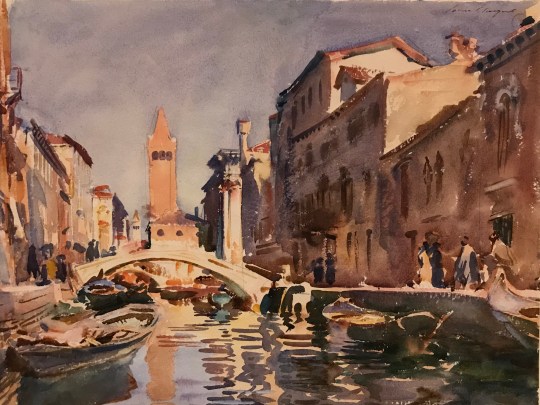
John Singer Sargent, Venetian Canal, 1913
For the focal point of this watercolor, Sargent chose the relatively obscure yet scenic eleventh-century tower of the Church of San Barnaba. He positioned himself close to the water to present the view looking down the Rio de San Barnaba toward the Grand Canal. Sargent’s watercolors are admired for their fluid spontaneity, evident here in his rendering of the rippling water of the canal as it reflects the nearby architecture and bright sunlight.
All pictures were taken by the author during his visit to The Met Fifth Avenue, New York. Texts sourced from exhibit label scripts.
Public Parks
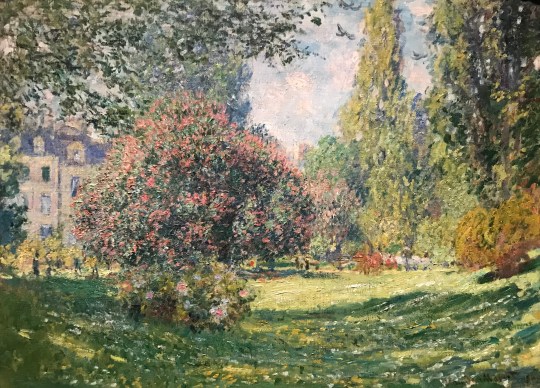
Claude Monet, Landscape: The Parc Monceau, 1876
The Parc Monceau in the elegant eighth arrondissement was among the older Parisian parks targeted for renovation and unveiled in 1861. Monet lived a few blocks away from this intimate park. At first he adopted a horizontal format, as in the views he painted of London’s Green Park (1870-71), but for the second group he used a more unusual vertical format, perhaps inspired by Japanese woodcut prints.
Claude Monet, The Parc Monceau, 1878
Monet takes in the park’s curving paths on a sunny afternoon. He skimmed lightly over the figures of park-goers, blending them in with enveloping vegetation, filling the canvas with little patches of color that approximate the texture of foliage and the flicker of light.
Gustave Caillebotte, The Parc Monceau, 1877
Like Monet, Caillebotte was drawn to the renovated Parc Monceau. He inserted a path the beckon viewers into the picture and a bench to invite them to linger. A solitary Parisian gentleman, achieved with just a few quick strokes, suggests the urbanity of the site.
Camille Pissarro, The Garden of the Tuileries on a Spring Morning, 1899Camille Pissarro, The Garden of the Tuileries on a Winter Afternoon, 1899
Later in his career, Pissarro — the least cosmopolitan of the Impressionists — devoted successive painting campaigns to the landscape of modern Paris. In 1899 and 1900, he took leave of his home in rural Eragny to rent a large apartment high above the rue de Rivoli “opposite the Tuileries, with a superb view of the garden”. He painted two series of fourteen views each, including half a dozen from the same vantage point. Attentive to changes in the light and color of the grounds, the relative fullness of the trees, and the comings and goings of strollers at different times and seasons, he extracted the very nature of this site.
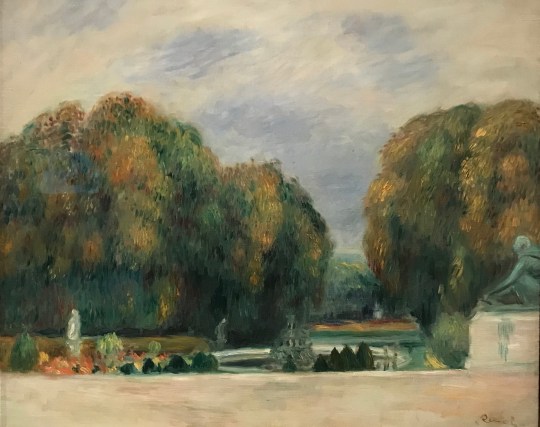
Auguste Renoir, Versailles, 1900-1905
Renoir gravitated to more traditional motifs during his later career. In this autumnal view of the courtyard on the north side of the palace of Versailles, he paints the chestnut trees that line the allée in rich seasonal hues, while he accords sculpture a key role.
Camille Pissarro, The Public Garden at Pontoise, 1874
By the early nineteenth century, virtually every town, large or small, was graced with a promenade or public garden not unlike the one Pissarro painted in Pontoise. In this semi-rural, semi-suburban hamlet just northwest of Paris, a stroll in the park was a social event.
Claude Monet, The Bodmer Oak, Fontainebleau, 1865
Monet studied the dramatic shapes and shadows formed by one of Fontainebleau’s most frequently painted and photographed trees, the Bodmer Oak, in preparation of his ambitious picture Luncheon on the Grass (1865-66). Using a palette of bright yellows, greens, and oranges to depict sunlight filtering through the trees, Monet painted this autumnal view just before he wrapped his visits to Fontainebleau in October 1865.
Floral Still Lifes
Mary Cassatt, Lilacs in a Window, 1880-83
One of Cassatt’s rare still lifes, this painting was presumably made at the country house her family rented outside Paris. She placed her casually arranged bouquet on the windowsill of the greenhouse, close to the open air, in cool spring light.
Claude Monet, Bouquet of Sunflowers, 1881
Monet was praised for the “brio and daring” of his technique when the picture was shown at the 1882 Impressionist exhibition. Such qualities seem to have resonated with Paul Gauguin six years later, when he was even more dazzled by the suite of Sunflowers Van Gogh has painted as a decoration for his room in Arles.
Vincent van Gogh, Sunflowers, 1887
By the summer of 1887, Van Gogh had updated his drab Dutch palette by painting flowers and come into his own as an original colorist. He made the dried blooms and stalks of the tall tournesols the focus of four works, magnifying their ragged heads, where flame-like sepals halo the seed destined to yield next year’s flowers.
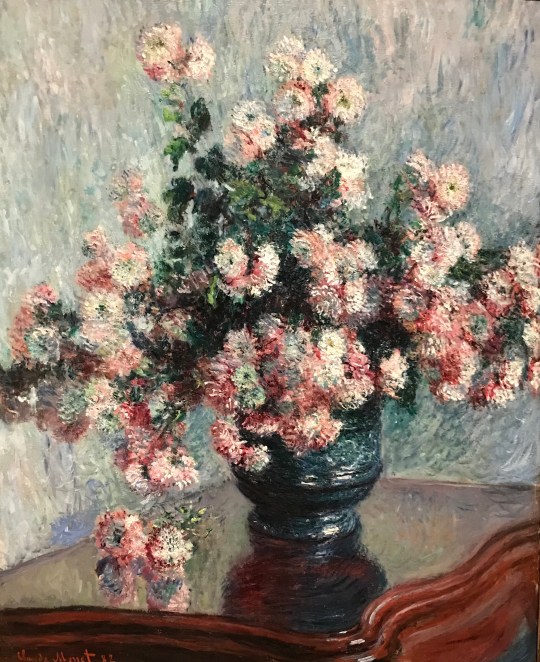
Claude Monet, Chrysanthemums, 1882
Monet painted more than twenty floral still lifes between 1878 and 1883, fixing his sight on generous displays of a single type of flower at the height of bloom as opposed to mixed bouquets. A perennial favorite was the exotic chrysanthemum. In painting the small, pearly mums of late summer with petal-size dabs and dashes, Monet created a shimmering effect that is reflected on the polished tabletop, mirroring his concurrent infatuation with the watery surfaces of the Seine.
Gustave Caillebotte, Chrysanthemums in the Garden at Petit-Gennevilliers, 1893
Caillebotte did not develop an interest in floral subjects until the 1880s, when he acquired property in the Parisian suburb of Petit-Gennevilliers. He found inspiration enough to shift his focus from urban scenes of bourgeois leisure to his own backyard. In redirecting his gaze to the plants he had nurtured from the ground up — such as this thicket of homegrown chrysanthemums, seen from an intimate and provocative vantage point — he continued to create what one critic hailed as “impromptu views that are the great delights in life.”
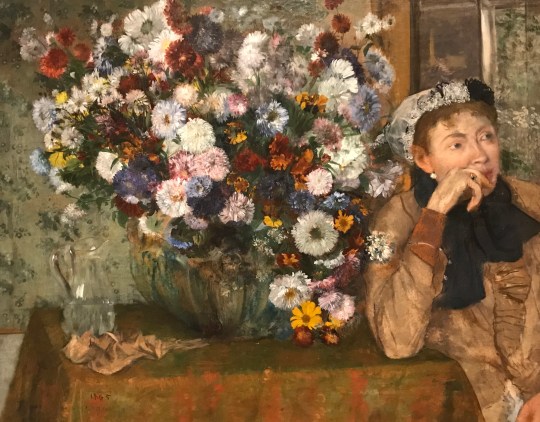
Edgar Degas, A Woman Seated beside a Vase of Flowers (Madame Paul Valpinçon?). 1865
Although Degas once expressed his aversion to scented flowers, he nodded to current fashion by portraying a woman seated beside an enormous bouquet of asters, dahlias, and other late-summer blooms. The gardening gloves and water pitcher on the table suggest that the sitter had gathered and arranged flowers from the garden glimpsed through the window.
Auguste Renoir, Bouquet of Chrysanthemums, 1881
The extraordinary range of hues in which chrysanthemums could be cultivated caught the eye of Renoir. Probably gathered from the garden of his patron Paul Bérard at Wargemont, in Normandy, they must have emboldened the artist to test his overheated palette. “When I painted flowers,” he said, “I fell free to try out tones and values and worry less about destroying the canvas.”
Eugène Delacroix, Dahlias, 1833 or 1847-48
Attentive to botanical accuracy, Delacroix brought a sense of realism to his works that was soon to become the province of photographers. And for younger painters, he set an influential precedent for how high-key color and freewheeling paint strokes could contribute robust vibrancy to a subject often too daintily treated.
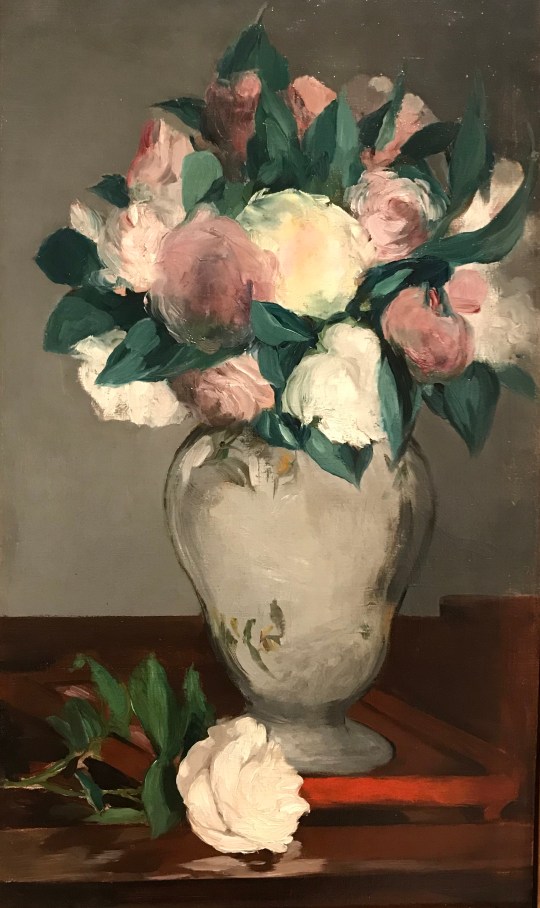
Edouard Manet, Peonies, 1864-65
Reportedly Manet’s favorite flower, peonies were introduced to France in the early nineteenth century. They grew in abundance in the artist’s garden in the Parisian suburb of Gennevilliers. Considered the epitome of luxury, the voluptuous flowers were a perfect vehicle for his sensuous brushwork and virtuosic handling of subtle color harmonies.
Private Gardens
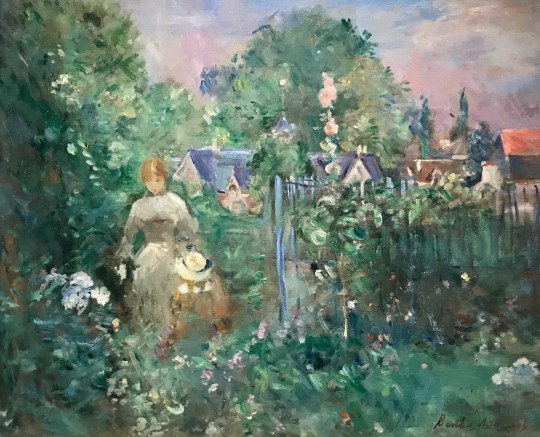
Berthe Morisot, The Gate at Bougival, 1884
During the summers of 1881 to 1884, spent with her family in the village of Bougival, just west of Paris, she often painted the garden of their rental house with its wrought-iron gate, tall hollyhocks, and dense foliage. The figures emerging from the verdant surroundings may be Morisot’s five-year old daughter, Julie, and their maid, Pasie.
Paul Cézanne, The Pool at Jas de Bouffan, 1885-86
Cézanne’s affection for his family’s estate, Jas de Bouffan, near Aix-en-Provence, is reflected in the many views he painted of the property over a quarter century. He pictured this prospect along the road that led from an eighteenth-century house to its landscaped gardens, charting the symmetry of the massive chestnut trees and often including the stone washing trough and large square pool for collecting water. A sense of cool tranquility prevails in the artist’s depictions of the garden that afforded him refuge from the challenges of life in Paris.
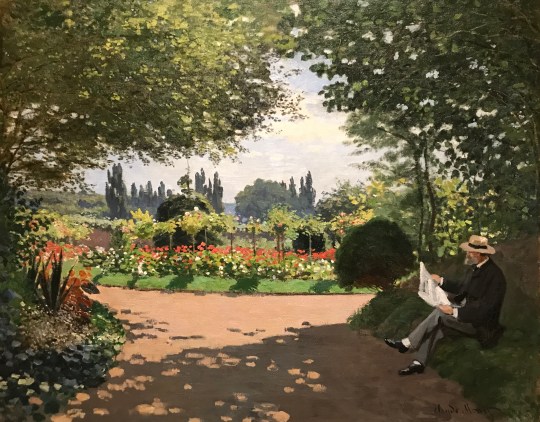
Claude Monet, Adolphe Monet Reading in the Garden, 1867
Monet was in his twenties when he began to setting up his easel in sunlit gardens. While spending the summer of 1867 with his family on the Normandy coast, he painted his aunt’s garden in the seaside resort of Sainte-Adresse, near the port of Le Havre. The manicured oasis of standard roses and bedding geraniums at her villa made a stunning setting for the artist’s sidelong portrait of his father, Adolphe, a prosperous merchant.
Claude Monet, Camille Monet in the Garden at Argenteuil, 1876
After Monet established his own bourgeois household in rented properties in the Paris suburb of Argenteuil between 1871 and 1876, he began to garden in earnest, making his flower-filled backyards the subject of more than thirty canvases. The artist planted a central flower bed in a walled circular space: gladioli and hollyhocks soar above nasturtiums and geraniums to provide burst of colors at laddered levels, in accord with the current fashion for mounded combinations of annuals and perennials. The hollyhocks grew taller than Monet’s wife, Camille, whose painted from dissolves in shadows, submitting to the primacy of flowers and foliage.
Pierre Bonnard, From the Balcony, 1909
With bemused sunlight, Bonnard pictures here a bucolic summer day at the family estate in Le Grand-Lemps, near Grenoble, adopting a high vantage point that offers a glimpse of five of his offspring and their pets cavorting amid the assorted greenery of vines, shrubs, and trees spread over luxuriant lawns.
Garden Portraits
Edouard Manet, Madame Manet at Bellevue, 1880
Manet painted his wife in the sunlit greenery of their seasonal residence in Bellevue. Much of her face is hidden beneath the broad rim of hat, and her figure melds with the background realized in bravura strokes of ocher, blue, and emerald green.
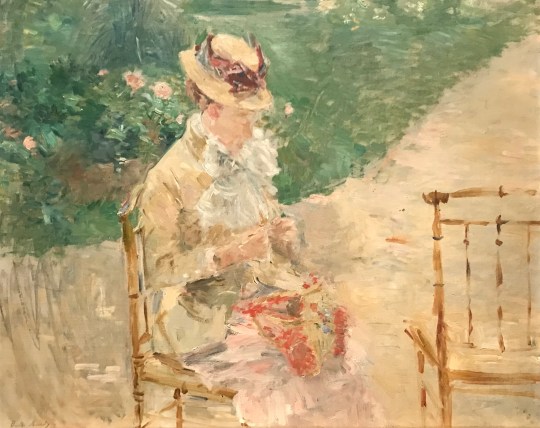
Mary Cassatt, Lydia Crocheting in the Garden at Marly, 1880
One of Cassatt’s first and most dazzling plein-air pictures, this portrait of her sister Lydia debuted to praise at the 1881 Impressionist exhibition. Lydia is placed along a diagonally receding walkaway, bordered by plants, inviting comparison with Morisot’s somewhat later picture of a sitter absorbed in her knitting. Cassatt rendered her frail sister’s features with sensitivity, using freer brushwork to describe her stylish dress and still more vigorous handling for the foliage of gladioli, roses, and coleus leading to the greenhouse.
Berthe Morisot, Young Woman Knitting, 1883
In this slice-of-life view, Morisot suspends descriptive detail to create a portrait of her time, making a bold fashion statement of sorts: her sitter sports the latest style of dress and is shown knitting in a garden typical of the period, with a gravel path and flowering roses. The elegant chairs suffice to define the private setting. Morisot probably painted the work in Bougival, where she spent the summers of 1881 to 1884, perhaps enlisting her daughter’s nanny as model.
Berthe Morisot, Young Woman Seated on a Sofa, 1879
At the time when artists were churning out sentimental images of women in gardens for the annual Salons, Morisot introduced invention where tired stereotypes left off. She magically transformed the interior into a place out of doors, opening it to her balcony and bringing roses and hydrangeas into the company of a flower-bedecked hat and the floral upholstery of a tufted settee. Her approach led one critic to comment in 1880: “She grinds flower petals onto her palette, in order to spread them later on her canvas with airy, witty touches.”
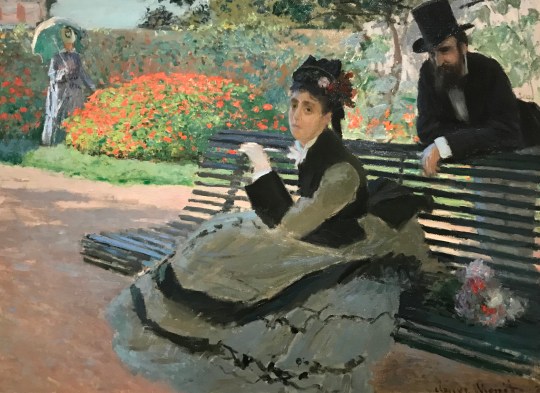
Claude Monet, Camille Monet on a Garden Bench, 1873
An echo of suitors in Garden of Love paintings from an earlier era. No less traditional is the presentation of the half-acre walled garden. Yet its bright red zonal geraniums are clustered in a corbeille, a basket-shaped flower bed that had recently become as much a fixture in French parks as the bench. Both the parklike setting and Camille’s smart ensemble ascribe to the latest fashion. Still, the sitter telegraphs sadness amid the sunlit blooms.
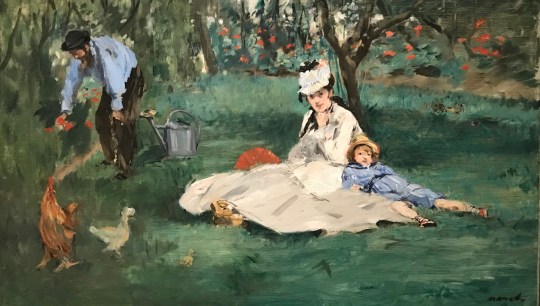
Edouard Manet, The Monet Family in Their Garden at Argenteuil, 1874
During the summer of 1874, Manet paid a visit to the Monet family. Finding them enjoying a leisurely afternoon in their garden, he set up his easel to paint in the open air. Renoir, who arrived just as Manet was starting to work, borrowed materials to paint the same scene from a closer spot. Looking to capture the moment, neither artist ignored the yard’s wandering chickens, Manet placing the rooster, hen, and chick as avian counterparts to Monet, his wife Camille, and son Jean. At some point of that day, Monet took a break from tending his flowers to make a picture of Manet painting in the garden.
在剧本创作阶段,这部电影的名字还是《羞耻之梦》(Dreams of Shame)。换句话说,现在在你眼前呈现的这部《羞耻》其实写得非常粗糙。电影的第一部分完全可以用一段十分钟的独白来替代,而之后发生的,则需要进一步展开,展开得越充分越具体越好。我在写剧本的时候完全没有意识到这些,在开拍的时候也没有意识到,甚至最终在剪辑的时候也是如此,整个过程中我都认为《羞耻》从头至尾都合乎逻辑,自圆其说。然而,现在看来,这样一份在拍电影过程中不知对错的心态反而是一件好事,因为它最大程度保护了导演的自尊心。拍电影是漫长而复杂的,过程中可以横生出各种枝节,如果在这之上你还要去应对自己脑子里那嗡嗡嗡的质疑之声,我想这世界上没有几个人能够完全承受这个过程中的艰辛和痛苦了。
Hitchcockian narrative obeys the law that the more a situation is somewhat a priori, familiar or conventional, the more it is liable to become disturbing or uncanny, once one of its constituent elements begins to ‘turn against the wind’. Scenario and staging consist merely in constructing natural landscape with its perverse element, and in then charting the outcome. … …Hitchcock systematically opposes suspense to surprise. He prides himself not so much on directing the actors — since he asks of his actors merely that they remain ‘neutral’, so that he can then edit a scene, a neutrality which he in fact takes some pleasure in testing by introducing postures which are frequently difficult, if not acrobatic — as on directing the audience.
在悬念过程中时间的刻意延长,实际上是一种类似情欲和色情的表现手法。
We are now in a better position to understand why Hitchcock should have insisted so often upon the paradoxical use of slowed-down time in suspense, … …This subjective stretching, this viscosity of time, is related to eroticism, and it concerns the eroticized time in the prolonged, necessarily disturbing undecidability of an event. Suspense is the erotic prolongation of the trajectory of a coin thrown up into the air, before it falls on one side or the other.
……There is a thesis implied on the structural level — not simply an obsession with duplication, but quite the contrary: every duality is based on a third. The third element is both excluded and introduced as a stain in this mirror-relationship, the object around which it turns and which fills the gap of the exclusion, makes then absence present.
意外的偶遇对于希区柯克的戏剧空间非常重要。
Accidental encounters, as already pointed out, are essential for Hitchcock’s universe. It is a universe governed by a ‘malign spirit’ which makes a chance event plunge a normal citizen into a nightmare, and it is the chance accident that reveals the structure into which the subject is implicated. The chance encounter basically takes the form of a joint between an element and an empty space, a void that was awaiting the subject like a trap.
The McGuffins signify only that they signify, they signify the signification as such; the actual content is entirely insignificant. The are both at the core of the action and completely irrelevant; the highest degree of meaning — what everybody is after — coincides with an absence of meaning. The object itself is a vanishing point, an empty space; it does not need to be shown or to be presented at all – as in Blow-up — an evocation by words is enough. Its materiality is inessential; it suffices that we are merely told of its existence.
3 Spatial Systems in North by Northwest by Fredric Jameson
… …In spite of the fetishzation of the visual and the voyeuristic in Hitchcock, these films rarely work towards the supreme moment of the production of the modernist image as such, the dissociation of the moment of vision from the narrative which become its pretext, as in the Dance of Death in The Seventh Seal, or the dramatic caricature of the whole process of image-production in the unexpected Last Supper of Viridiana.
… …what can equally well be argued is that in that sense Hitchcock’s images are never historical. Historicity — the urgent sense of the year, the date, the decade, the cut of the hair or the dress, the model cars, the ideological and current-event preoccupations of a time in a particular place — is never active in Hitchcock, not even in the pretexts of the ‘Balkan’ or Nazi films, much less in the feeble Cold War efforts.
4 A Perfect Place to Die: Theatre in Hicthcock’s Films by Alenka Zupancic
For Hitchcock himself, the birth of a ‘pure film’ is the moment when Griffith’s camera overstepped the barrier of the stage and thus discovered a new subject of the gaze — the film subject. … …The emergence of the specific cinematic view does not coincide simply with the invention of cinema. The decisive break between film and theatre occurred within film itself, when filmmakers ‘changed the paradigm’ by ceasing to think in terms of theatre and beginning to think in terms of film; more precisely, when the camera stopped being a mere mediator, the recorder of a specific theatrical vision, and became an ‘organ’ with which the filmmaker thinks — a creator of its own vision.
“戏中戏”呈现的其实是原本就缺失的东西,它第一次出现的时候就已经是原件的复制品。
… …The structure of the play scene is precisely the structure of what psychoanalysis conceptualized as Vorstellungs-Reprasentanz: we are dealing with the representation of something which is originally missing; with something that can appear only as duplicated and appears already the first time as its own repetition: its only original is this very repetition.
5 Punctum Caecum, or, Of Insight and Blindness by Stojan Pelko
Raymond Bellour derived from this case some far-reaching conclusions about the role of a static photographic image in the dynamic stream of cinematic moving pictures:
By creating distance and another time, the photograph allows me to think in the cinema. It allows me to think the film as well as the very fact of being in the cinema. In short, the presence of the photograph allows me to cathect more freely what I see. It helps me (a little) to close my eyes, though they keep on being open.
… …After all, it is precisely this elusive juncture of pondering eyes and dimmed mind around which Alfred Hitchcock builds his cinematic universe. Because of that, by necessity, he himself appears at a similarly elusive juncture — at the juncture of classic and modern cinema.
1.1-1.5 大事记
CFIUS to block Ant-Moneygram deal

1.8-1.12 大事记
Dropbox files IPO
Moneygram to work with Ripple Labs

1.15-1.19 大事记
Bitcoin plunged by 20%
GE is considering breaking up

1.22-1.26 大事记
Meg Whitman to join WndrCo
Saudi buys 25% stake in Clariant from activists

1.29-2.2 大事记
Keurig to buy Dr. Pepper Snapple for $19bn
SAP acquires Callidus for $2.4bn
Alibaba to acquire 33% in Ant Financial

2.5-2.9 大事记
Broadcom raises bid to $121bn

2.12-2.16 大事记
Baidu consider listing iQiyi in the U.S.
Cisco to bring $67bn foreign cash back to the U.S.

2.19-2.23 大事记
Albertsons to buy Rite Aid

2.26-3.2 大事记
Microchip to buy Microsemi for $8.3bn
Amazon acquires Ring for $1.1bn
iQiyi files for IPO
P&G slashed $200mm digital ad spend last year

3.5-3.9 大事记
Gary Cohn resigns
Cigna to buy Express Scripts

3.12-3.16 大事记
Trump blocked Broadcom-Qualcomm deal

3.26-3.30 大事记
Arizona suspends Uber self-driving cars
DocuSign files for IPO
Walmart in early talks to buy Humana
Museum of the Moving Image’s Introduction on Le Bonheur: In Varda’s exquisitely colorful movie, a seemingly happy married carpenter takes a mistress. Though set in bucolic landscapes and filmed with a vividly stylized and vibrant palette, Le Bonheur is sharply analytical beneath its sunny exterior, as disturbing as it is beautiful. Describing the film, Varda said “I imagined a summer peach with its perfect colors, and inside there is a worm.”
BAM’s Introduction on Lynne Ramsay’s Retrospective Series: Through her complex layering of sound and visuals, transformative use of pop music, and knack for capturing lightning-in-a-bottle performances, Ramsay creates senses-shattering spectacles of hallucinatory beauty and raw psychological power.
New Directors New Films 2018’s Introduction on An Elephant Sitting Still: Sure to be remembered as a landmark in Chinese cinema, this intensely felt epic marks a career cut tragically short: its debut director Hu Bo took his own life last October, at the age of 29. The protagonist of this modern reworking of the tale of Jason and the Argonauts is teenage Wei Bu, who critically injures a school bully by accident. Over a single, eventful day, he crosses paths with a classmate, an elderly neighbor, and the bully’s older brother, all of them bearing their own individual burdens, and all drawn as if by gravity to the city of Manzhouli, where a mythical elephant is said to sit, indifferent to a cruel world. Full of moody close-ups and virtuosic tracking shots, An Elephant Sitting Still is nothing short of a masterpiece.
One major subject: the Japanese family; one major theme: its dissolution – family members moving apart; two main extensions: the school and the office
“The father or mother sitting alone in the now empty house is an image common enough in Ozu’s films … … These people are no longer themselves. We know they will somehow survive, but we also know at what cost … … The reason they impel our sympathy is that they are neither victims of their own flaws, nor the prey of a badly organized society; they are the casualties of things as they are, the way that life is.”
Only in early films [he] emphasized the external social conditions; in later films the director found more important the constraints on human conditions; The more pleasant bourgeois life is “no less real”; Ozu abandoned the idea that unhappiness is caused solely by social wrongs
Ozu story is a pretext: “It is not the story that Ozu wants to show so much as the way his characters react to what happens in the story, and what patterns these relations create.”
The technique: highly restricted; the titles: similar; same actor in the same kind of role, [also] same story line in various films; activities: also consistent; and [Ozu’s] liking for trains – a vehicle of mystery and change; photograph for nostalgia, [while] death is simple absence
There is no such thing as Human Nature, only individual men and women – “By so restricting our view and confining our interest, Ozu allows us to comprehend the greatest angle aesthetic paradox: less always means more … … the several invariably indicates the many; restriction results in amplification; endless variety is found within the single entity.”
Script
a) Plot and Characters
Light story lines, rendered even slighter by its conventionality – marriage and death are the only conclusions
Ozu’s method resembled that of directors of animated films or musical comedies who construct their film around a finished sound track. One result of this method was the creation of characters that in no way depended upon the convolutions of plot or story.
“The character became real with no reference to story or plot; he became real because all the words he spoke gave expression to those principles of his character which it was the writers’ duty to discover.”
Heightened realism: the characters say just what they would say, yet the dialogue continually surprises because it is always unfolding facets of the character that we were hitherto unaware of
Ozu disliked plot: his curiosity and interest in people so great, that he denied himself the undoubted convenience of story, plot, and conventional dialogue … … The resultant lovability of [his] character, … … is based on his perfect freedom and consequent fullness
In the Ozu script no character description beyond simple indication is given; instead lines of dialogues that carry their own inflections. “The viewer of an Ozu film is expected to infer the characters’ feelings, and usually the dialogue is so beautifully written that reasonably attentive viewers do just that, whether consciously or not. … … in the films of Bresson and the earlier pictures of Antonioni, though, thoughts and feelings are so lightly implied that we must infer most of the motivation. The same is true of the Ozu films; as in the middle novels of Henry James, we are shown everything and told nothing.“
b) Humor, Parallel, and Inconsistency
Humor: formed by logical incongruities; repeating jokes, repeating character traits, led naturally to the formation of character
In the Ozu film there is often a minor motif running parallel to the main theme or story, and to an extent, both presaging and sustaining it: 1) The variations may be presented as contrasting with each other, or one variation may continue another. 2) More often, however, the parallels running side by side do not meet and stretch into infinity. 3) Sometimes, Ozu’s parallels are purely pictorial – the same scene is shown again and again, its presence supporting the theme of the film. 4) The most satisfying parallels are the few that are readily recognizable which fit the film and amplify it but whose connection with the main theme remains elusive (e.g. in An Autumn Afternoon, the old-time war song)
“Parallelism was the mainstay of Ozu’s method of film construction because it enables him to show what he wanted without telling us what we should be thinking and feeling.”
There is nowhere in [Ozu’s] work a scene of which the real, intended meaning is contrary to the one seemingly expressed. “Rather, a character reveals his belief to be the contrary of those he expresses, or maintains a belief different from the one reality quite apparently imposes. In Ozu’s work, such self-deception is, as the father in Equinox Flowers plainly states, proof of humanity.“
c) Irony, Mono no aware, and Surprise
Ozu’s irony makes us want to move closer to [those] very warm and human people, [contrary to] the traditional functions of irony ([makes] wholesale empathy impossible). Many of the ironies are neither explained nor exploited. Our detachment reveals a design of which the characters are unaware
Mono no aware (“sympathetic sadness”): a serene acceptance of a transient world, a gentle pleasure found in mundane pursuits soon to vanish. “Ozu’s characters are all without pasts and only very occasionally and indirectly suffer because of some past action of lack of one. But the present matters because it is all we have. One should … … not bemoan its gradual disappearance because that is the way things are … …”
Ability to contemplate; silent contemplation; long still shots of characters simply existing; a scene of simple savoring of the moment; appreciation of the weather ([so that] our thoughts are soothed and our spirits renewed)
“Ozu’s films are made of so little, his characters composed of so apparently few “traits”, … … He rarely gives his characters any identifying props, and yet they surprise.”
Ozu’s characters often display opposite extremes of emotion; beneath every one of the emotions we normally show, there lies its opposite. “When such concealed emotions, powerful and long denied, break out, they show — no matter who we are — how akin we are to everyone else.”
d) Moralist and Artist; Life and Choice
The message of Ozu’s film, is, perhaps, that one is happiest living in accord with one’s own imperfections include aging, dying, and other calamities .- seen in this light, Ozu was a truly moral man … … He was also an artist, and thus expressed his moral views only indirectly
In Ozu’s universe there is no afterlife, [and his] view of life is not, indeed a comforting one. “Most of Ozu’s films are about parents and children, all of whom suffer a degree of disappointment … … This disappointment is built into the human condition, as many an Ozu character learns during the course of the picture. They begin by hoping that all will be well, that things will turn out as they wish; they often end by consoling themselves that at least they have suffered less than others they know.”
“Loneliness and death are in a sense such banal facts of human experience that only a great artist, a Tolstoy, a Dickens, an Ozu, can restore to them something of the urgency and sadness that we all someday experience … … Ozu is one of the very few artists whose characters are aware of the great immutable laws that govern their lives.”
Choice is important to all of Ozu’s people: you are what you do, and nothing more or less; the sum total of your choices, your actions, is the sum total of yourself. Here, perhaps, is the reason why Ozu’s characters have no past (Ozu never once in his entire career used a flashback) – what is important is not what life has done to them, but what they do with what life has done to them. Then, one understands Ozu’s dislike and distrust of plot … … one understands also why inconsistency of character is so important to Ozu: it is a sign of life because it is a sign of choice
Shooting
a) Camera Movement and Angle
Ozu’s later films [make me] think harder and feel more, and hence [my] experience is the deeper. In the circumstances we must supply the emotional direction ourselves, and doing so heightens our emotional involvement, brings us closer than we can be when our reactions have been foreseen and foreordained … … we think more, but it does not follow that we felt less
Ozu relinquished most of the grammatical elements of cinema: he did not want to express himself in a direct way; he refused elements of film grammar because they express conventionalized opinion
The low camera angle made it possible to sharply delineate the various surfaces of the image and to accentuate the one occupied by the actors; [It] has the effect of creating a stage upon which the characters are seen to best advantage
b) Appreciation of the Present Moment
We are obliged to watch the entire selection when the Ozu character performs. Ozu would have us listen to the whole long song not only out of a sense of politeness, but for its own sake, out of a sense of pleasure; (Zen) when one does something one does noting else; the present moment is immortalized [in the scene at the end of Late Spring]: “As we watch the skin fall away, it is the concentration on the present we appreciate and, if we are like Ozu, admire. It is when the hands stop moving, the knife remains poised, the peeling remains unfinished, it is when the father looks up with vacant eyes, that we know he is, after all, like us — that the present is now lost in the future with its hopes and its fears, that he is feeling his loneliness.”
c) Composition and Symbols
Ozu was interested in composition within the single shot, [instead of] harmonizing the composition of succeeding shots; [he] worked to create the kine of geometry necessary to satisfy his sense of beauty
[Ozu’s] compositions, like most Japanese pictorial compositions, are the main horizontal. Such compositions suggest the known, the content, even the serene. Vertical and diagonal compositions, by contrast, suggest striving, the unknown, even the discontent. The invariable low horizon of the Ozu film helps create the accepting atmosphere of these pictures
The vase in Late Spring: it is the pretext for an amount of elapsed time; it is something to watch during the period in which the feeling of the daughter change … … “In being shown only the vase during the crucial seconds when she comes near tears, we are put into the position of having to imagine her feelings. Although we do not necessarily imagine that she will be near tears when we next see her, the vase has occupied our attention while we were occupied with her feelings, and we consequently accept her feelings, no matter what they are.”
d) Acting and Directing
In most of his mature films, Ozu demanded not emblematic gestures, but a wide though restricted range of actions that would achieve the desired effect. [Ryu]: “Ozu told me to stare at the end of my chopsticks and then stare at my hand and then speak to my child. The simple act of doing these things in that order conveyed a certain feeling. Ozu did not explain the feeling; the actions came first. He told me what to do and let me discover the feeling.”
Just as he remained relatively uninterested in the changing social conditions of his country, [Ozu] is uninterested in a naturalistic picture of his people. He is interested, precisely, in the known, mundane, and certain society, that can provide a frame or his observations on life, death, and other imponderables … … “For this reason, perhaps, almost all the characters in an Ozu film already know one another before the film begins.”
The underlying assumption of an Ozu film is that a person is always in control of himself … … “We are not allowed that vicarious and easy pleasure of knowing more about the character than he himself does … … given this kine of character delineation, the whole question of fault never rises.“
Editing
a) Form and Transition
As we have seen, Ozu did not want to interpret; he wanted to present; for him there was only one way of editing – following the script. He followed it carefully and undeviatingly because the impact of his film depended on his realizing previously calculated effects, mainly those concerned with form and tempo
Circular form: life has revolved, and we are back where we started but with a difference (see Tokyo Story). Showing us this difference is the purpose of the film … …
Transition: usually indicated by two shots; the first shows an outside view of the place we have just been, the second an outside view of the place we are going. Other methods include [showing] only what the characters are experiencing, [which] appears both logical and natural; [using] objects as transitional devices, like the bicycle in A Story of Floating Weeds
Ozu’s still lifes and otherwise empty scenes become containers for our emotions. Empathy is not the key here. Primary to the experience is that in these scenes (like the vase in Late Spring) empty of all but mu, we suddenly apprehend what the film has been about, i.e., we suddenly apprehend life. “…. … Ozu has ensured that we sense something larger than the emotion we are both seeing and feeling, that at the same time we become aware of the universality of all emotion — in short that we feel something of the texture of life itself and again know that we are part of this universal fabric. Empathy is thus transformed into an appreciation, and experience into personal expression.”
Schrader: [the shot of the vase (a long one, lasting some ten seconds)] “can accept deep, contradictory emotion and transform it into an expression of something unified, permanent, transcendent.”
b) Tempo and Sequence
Indeed there is a question whether Ozu “knew” what he was doing … … The long close-up of the vase is not in the original script for that picture. Its proper length and position were something that became apparent only during the course of creating the film … … Certainly, his editing methods were largely a matter of “feeling”
Ozu usually continued [conversation scenes] past the point of silence, letting the camera run after conversation stops … … This gives an air of importance, of weight, to almost any conversation
The Noh drama scene in Late Spring: it would have been made rapidly, and we would then be rushed to the next sequence. [However,] Ozu has added shot after shot as a painter would apply brush strokes, each one contributing to the final impression … … In doing so, he created a feeling of actuality, … … and he took the amount of time we needed both to be convinced of what was happening and to apprehend the event’s emotional effects on father and daughter
The visual form of the Ozu sequence is the binary a-b-a, so the temporal form of the sequence is slow-fast-slow. “All aspects of an Ozu film, then, dialogue, scene, sequence, sound, were patterned; they were module-like units … … One reason Ozu can successfully impose such a pattern upon his material, can do so, that is, without falsifying, is that the sequence pattern is not the story pattern … … The higher authority in Ozu’s picture is the unvarying structure of the film itself, and not, as in most films, story or plot.”
“Certainly the immediacy of the Byzantine mosaic portraits is occasioned in part by the rigor and sameness of their patterns; certainly much of the joy of a Bach fugue is caused by the inflexible rules of fugue-writing itself, just as part of the magical realism of a Vermeer interior is attributable to the rigid geometrical composition. Or, better, perhaps all this life and joy and recognizable realism results from the overcoming of various rules and patterns. Perhaps it is restriction that creates amplitude; perhaps less always means more.”
Conclusion
“While working with completely traditional material and using traditional means, Ozu has had the energy and insight to prevent the formal from becoming formalistic, the form from becoming empty, and the spirit from becoming the mere letter … … Ozu’s characters have a validity beyond their role in the film. It is possible for us to imagine them continuing their lives. Indeed, it is impossible for us not to. Having spend a few hours with them, we find that we do not want to leave them. We have come to understand and consequently to love them. And with this understanding we come to know more about ourselves, and, with that, more about life.”
All pictures sourced from external links as Neue Galerie New York does not allow visitors to take photos. Notes from the museum audio guide.
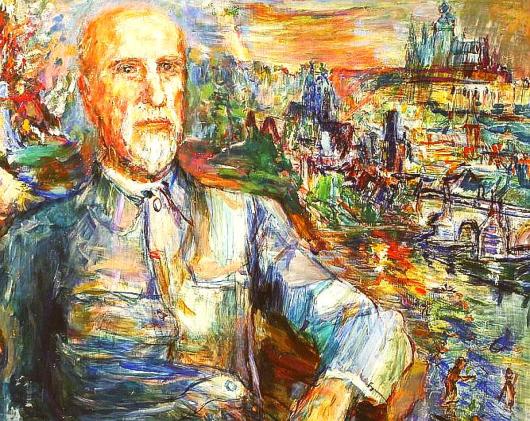
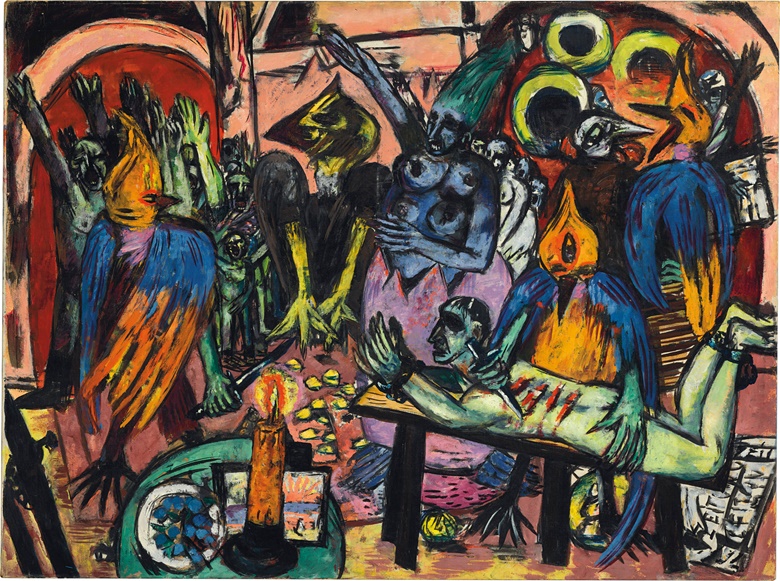
Sunrise, Max BeckmannTwo Heads, Rudolf WackerPortrait of Tomas Garrigue Masaryk, Oskar Kokoschka, 1935-36
The first president of Czechoslovakia. Setting him against the backdrop of Prague and Vltava river. Extraordinary brushwork. Shortly after Kokoschka finished this painting, the Nazi called it ‘degenerate’ and he fled to London. Tomas Masaryk died in 1937 and this painting became an elegy for this loved president.
Birds’ Hell, Max BeckmannParis Society, Max Beckmann, 1931
Here beckmann portraits real people: intellectuals, politicians, and businessmen. This is an elegant party – there is singer at the background but no one pays attention.The guests don’t seem to enjoy themselves; only the couple at lower left seems to be connected to each other. The main aspect of this painting is isolation.
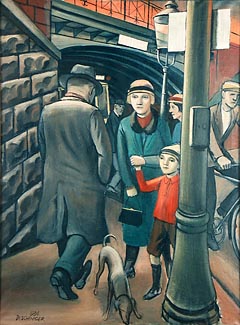
Self Portrait with a Horn, Max BeckmannRailway Underpass, Rudolf Dishinger, 1934Threat, Rudolf Dischinger, 1935
The style and implication of this painting would have been unacceptable to the Nazis and clearly the artist painted it for himself. Has a scientific fiction in it. The barren room, the door that goes nowhere, and the empty frame on the wall. Perhaps this an artist studio but the productivity has been totally gone.
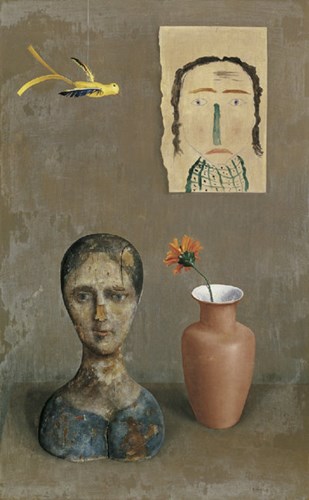
Expectation, Richard Oelze, 1935-36
Oelze drew a variety of sources for this unsettling composition: the use of contemporary photography, combined with traditional European landscape painting – the genuine strategy of surrealism. MoMa bought this painting in 1940.
Literacy will become as rare as any other specialized skill, because prose was based on the power to translate picturgrams into syntactical gestures and grammatical perspectives – and these are of little interest to the ordinary person today
The decline of literary skill is more likely connected with the passivity of modern audiences and the consequent disappearance of conversation
The values of civilization would seem to be best created and maintained where there is a great deal of face-to-face discussion
The Comics and Culture (1953)
图像技术的到来并未伴随着与之相称的理解图像能力的提升
Culture has during the past four hundred years been, for the most part, book-culture
Printing fostered nationalism, … [and] proved to be a great setback for the visual and plastic arts
In our own time technology has restored pictorial communication to a public which is completely untrained in pictorial discrimination
The “low intensity” or “low definition” of retinal image elicits high empathy or participation on the part of the viewer
J.C. Carothers: people who live in an oral-aural world know none of the impersonal and detached attitudes of a visual-literate people
TV has the power of imposing its own conventions and assumptions on the sensibilities of the viewer. It has the power of translating the Western literate back into the world of non-literate synesthesia
Cybernation and Culture(1966)
三维和图像化的信息只摘选了一个瞬间,并不能成功地描述更普遍的人类情感
The story line as a means of organizing data has tended to disappear in many of the arts
Sculpture does not enclose space. Neither is it contained in any space. Rather, it models or shapes space
Georg Von Bekesy: the world of flat iconic image is a much better guide to the world of sound than three-dimensional and pictorial art [which] selects a single moment in the life of a form
The flat iconic image gives an integral bounding line or contour that represents not one moment or one aspect of a form, but offers instead an inclusive integral pattern
Environment: The Future of an Erosion (1967)
当代的技术和媒介像周边环境一样让人不易感知到它的存在,而逝去的媒介则由环境演变成了一种艺术形式
Every new technology creates an environment that translates the old or preceding technology into an art form
The form of movie which once was environment[al] and invisible has been re-processed into an art form
The artists as a maker of anti-environment becomes the enemy in society. He doesn’t seem to be very well adjusted. He does not accept the environment with all its brainwashing functions with any passivity whatever
Literate man [refused] to be involved in the world he lived in. He valued the isolated, delimited self, particularly the mind
In the tribal world, art belongs to ordinary day-to-day experiences: painting lives on the body, sculpture is something you use or worship, architecture you do yourself, and literature you recite or dance
Misako Miyamoto: The audience watches the play and catches the feeling through not only the action and words but also the intervals of the period of the pauses. There is a free creation in each person’s mind … and the audience relates to this situation with free thinking
Foreword to Harold A. Innis, Empire and Communications (1972)
现代科学更强调对因果关系的量化研究,而古希腊时代的自然科学则关注分类而非模式识别
Since the Renaissance, science has tended increasingly to quantify cause and effect and to assign as much as possible one effect to one cause
Greek physis or “nature” was more a system of classification than of the recognition of dynamic patterns in experience
Unlike radio and phonograph, the book does not provide an environment of information that merges with social scenes and dialogue
Today, the printed book is the means of detachment and civilized objectivity in a world of profound sensuous involvement
Reading and writing were assigned to slaves in ancient Greece, and it was the Romans who promoted the book to a place of dignity
The Brain and the Media: The ‘Western Hemisphere’ (1978)
现代科学和现代社会大多是由左脑支配的,更加注重线性逻辑和用理性指导活动,而非基于全然和同时的感知
Non-literate culture are mainly oral/aural, even when they cultivate some non-phonetic form of writing such as Sanskrit
The linearity of the left hemisphere is reinforced by a service environment of roads and transportation, and logical or rational activities in legal legislation. The dominance of the right hemisphere, on the other hand, depends upon an environment of a simultaneous resonating character, as is normal in oral societies
艾玛出场时,双手背后笔直地站着,背后是肃穆的白墙,象征着秩序和规则。她对即将到来的工作有些忐忑,远不及对自己的个人生活前景来得有信心。这种忐忑,既源于二人身份的不对等(功成名就的演员 vs. 初出茅庐的护士),也源于她对沉默本能的抗拒——似乎冥冥之中,沉默会通向她心中那些不可告人的恶魔,和看似平静生活背后更深一层的不安。而后来的故事情节也印证了,艾玛与伊丽莎白接触的过程,正是她“卸下”护士这一身份角色的过程。
Criterion Collection’s Introduction on Wild Strawberries: Through flashbacks and fantasies, dreams and nightmares, Wild Strawberriesdramatizes one man’s remarkable voyage of self-discovery. This richly humane masterpiece, full of iconic imagery, is a treasure from the golden age of art-house cinema and one of the films that catapulted Ingmar Bergman to international acclaim.
Criterion Collection’s Introduction on Persona: In the first of a series of legendary performances for Bergman, Liv Ullmann plays a stage actor who has inexplicably gone mute; an equally mesmerizing Bibi Andersson is the garrulous young nurse caring for her in a remote island cottage. While isolated together there, the women perform a mysterious spiritual and emotional transference that would prove to be one of cinema’s most influential creations. Acted with astonishing nuance and shot in stark contrast and soft light by the great Sven Nykvist, Persona is a penetrating, dreamlike work of profound psychological depth.
Criterion Collection’s Introduction on Cries and Whispers: An intensely felt film that is one of Bergman’s most striking formal experiments, Cries and Whispers (which won an Oscar for the extraordinary color photography of Sven Nykvist) is a powerful depiction of human behavior in the face of death, positioned on the borders between reality and nightmare, tranquillity and terror.
Criterion Collection’s Introduction on Scenes from a Marriage: Shot in intense, intimate close-ups by master cinematographer Sven Nykvist and featuring flawless performances, Ingmar Bergman’s emotional x-ray reveals the intense joys and pains of a complex relationship.
A.O.Scott’s Review on Western: Geopolitics and global economics are elements in the atmosphere, less themes of the movie than part of the air its inhabitants breathe. It’s worth noting that Maren Ade, whose “Toni Erdmann” is also about a German expatriate in a Balkan country, is credited as a producer of “Western.” (Ms. Grisebach was a script consultant on “Toni Erdmann.”) Both films combine highly specific individual narratives with sharp, critical scrutiny of the way the world is organized now — the imbalances of power and autonomy that inevitably, though not always predictably, influence the ways people behave toward one another.
New York Times’ Bosley Crowther on The Virgin Spring:In all of this representation, Mr. Bergman has achieved a tremendous sense of mental heaviness, primeval passion and physical power. … …Each character may be a representation of some contemporary element in the world. But we rather feel Mr. Bergman has here given us nothing more than a literal, very harsh, very vivid and occasionally touching statement of a moral. When water springs from the earth beneath the dead child, after the father has repented his wrong, the simple — almost naïve — conception is resolved in a miracle.
















,%201935%201b.jpg)

 gz64
gz64 