All pictures were taken by the author during his visit to The Museum of Modern Art, New York. Texts sourced from exhibit label scripts and museum publication excerpts.
Matisse: The Red Studio
Henri Matisse, Corsica, the Old Mill, 1898
Henri and Amelie Matisse spent the first six months of their married life in Ajaccio, Corsica, where Matisse encountered the Mediterranean sun and sea for the first time. The experience transformed his painting and palette, with realistic description giving away to compositions built primarily on color. The parklike property of this former olive farm was on of Matisse’s favorite sites in Ajaccio; here, his representation of light dissolves details such as the trunks of the olive trees and the door at the top of the stairway.
Henri Matisse, The Red Studio, 1911
“Where I got the color red—to be sure, I just don’t know,” Matisse once remarked. “I find that all these things . . . only become what they are to me when I see them together with the color red.” This painting features a small retrospective of Matisse’s recent painting, sculpture, and ceramics, displayed in his studio. The artworks appear in color and in detail, while the room’s architecture and furnishings are indicated only by negative gaps in the red surface. The composition’s central axis is a grandfather clock without hands—it is as if, in the oasis of the artist’s studio, time were suspended.
Henri Matisse, Large Red Interior, 1948
Large Red Interior depicts a corner of Matisse’s house in Vence, France, where he lived and worked from 1943 to 1949. It shares with The Red Studio the art-within-art device that had remained a constant for Matisse throughout the decades. Only now, however, does the radical flatness of the 1911 painting return.
Henri Matisse, Studio, Quai Saint-Michel, 1916-17
In many ways, this composition is the antithesis of The Red Studio. Matisse describes the room in clear material details and renders the works of art as virtually blank. In addition to showing a model and a work in progress, it presents a view that vividly brings together indoors and outdoors. Encompassing the full height of the room from the zigzagging floorboards to the scalloped ceiling, Studio, Quai Saint-Michel conveys the closeness of Matisse’s small quarters during the war years, when he spent winters at his Paris apartment.
Henri Matisse, The Blue Window, 1913
This is the sole painting in which Matisse depicted the exterior of his Issy studio. The view through the window shows the studio nestled in the surrounding trees (painted blue, like the dressing table, wall, and sky). The studio’s distinctive pitched roof and chimney are also reimagined as blue, while the yellow of the building’s exterior links it to the objects on the table. In one flat plane, Matisse connects inside and outside, home and work, life and art.
Henri Matisse, Still Life and Geraniums, 1910
This painting was made a few months after Matisse moved into the Issy studio and is his only still-life composition that portrays the wood-paneled walls naturalistically, albeit in blue. A distinctive wooden table occupies the center of the composition. A pot of geraniums and a cloisonne Japanese jar grace the table, across which a floral fabric is draped. The true star of the painting, the flowing textile pulls the real flowers of the geranium and the painted flowers of the ceramic into its own decorative hum.
Appendix I: Collection 1880s-1940s
Pablo Picasso, Three Women at the Spring, 1921
In this painting, the three classical graces gathered at a water source are depicted as a series of solid, sculptural forms that diverge from the modern language of flattened abstraction with which Picasso was also experimenting during this moment. With their terracotta skin and fluted white garments, the women resemble the earthenware vessels in which they gather water, or columns from the ancient world, offering a reassuring link to tradition after the chaos of World War I.
Henri Matisse, Dance (I), 1909
Dance (I) marks a moment in Matisse’s career when he embraced a reductive approach to painting, seeking the expressive potentials of fundamental elements: line, color, and form. Across this monumental canvas Matisse used only four naturalistic colors: blue for the sky, green for the ground, and black and pale pink in rendering the five figures. When it was painted, its simplification of the human body and radical elimination of perspective were attacked as inept or willfully crude, but Matisse felt that it evoked “life and rhythm.”
Gustav Klimt, Hope, II, 1907-08
Although images of women and children are frequent in the history or art, depictions of pregnancy are rare. Klimt was among the many artists of his time who combined archaic traditions–here Byzantine gold-leaf painting–with a modern psychological subject. The artist’s preoccupation with formative drives like sex and death paralleled Freud’s explorations of the psyche.
Pablo Picasso, Two Nudes, 1906
The terra-cotta shades and heaviness of the figures in Two Nudes derive from Picasso’s interest at the time in the ancient Iberian sculpture of his native Spain. Like the woman in Demoiselles, with whom she shares a chiseled nose and dark, hollow eyes, the nude seen here holds open a curtain and gazes toward, as though inviting us in.
Paul Cezanne, Still Life with Apples, 1895-98
“Painting from nature is not copying the object.“ Cezanne wrote, “it is realizing one’s sensations.” In this work the artist demonstrates that a still life can be more than an imitation of life–it can be an exploration of seeing and of the very nature of painting. Here, some areas of canvas are left bare, and others, like the drape of tablecloth, appear unfinished. Rules of perspective, too, are broken: the right corner of the table tilts forward and is not aligned with the left side.
Appendix II: Collection 1940s-1970s
Simon Hantai (French, born Hungary), Untitled [Suite “Blancs”], 1973
Hantai executed this work using his signature method of “pilage”, or folding: he knotted parts of an unstreteched canvas, brushed on paint, and then, once they acrylic had dried, untied the surface to reveal interplays of paint and ground. What looks like a playful image is in reality the chance of outcome of a highly technical procedure. Hantai developed an approach that combined features from diverse art movements, including Surrealism’s automatism–in which conscious control is surrendered–and Pop’s and Minimalism’s elimination of traces of the artist’s hand.
Lee Krasner (American), Gaea, 1966
Titled after the ancient Greek goddess of the earth, Gaea is composed of floral colors and organic, somersaulting shapes that reflect the artist’s abiding fascination with the natural world and its primeval origins. Though she painted abstractly, Krasner rejected the notion that her painting was devoid of content—she “wouldn’t dream of” creating a painting from a fully abstract idea, she said. In works like this one, titled after the Earth goddess of the ancient Greeks, the artist claimed to be “drawing from sources that are basic.”
Sonja Sekula (Swiss), The Town of the Poor, 1951
The ghostly scaffolding, swooping calligraphic lines, and blue and yellow washes of this painting most likely depict the view from Sekula’s downtown New York studio, which she shared with composer John Cage and choreographer Merce Cunningham. “Looking outside my window,” wrote the Swiss painter and poet, an immigrant to the United States, “I think of all the contemporary American poets and artists who represent their outlook on this strange country and I find myself beginning to realize that I shall be one of them. I shall begin to speak of … a future that we begin to feel underneath the current of war and strife and uncertainty.”
All pictures were taken by the author during his visit to The Met Fifth Avenue, New York. Texts sourced from exhibit label scripts.
Winslow Homer: Crosscurrents
Winslow Homer, The Cotton Pickers, 1876
The Cotton Pickers is Homer’s most monumental representation, in form and content, of life for the newly emancipated in Reconstruction-era Virginia. Two sensitively rendered laboring women appear poised between their past, present, and future. The work’s complexity–of figural characterizations–is grounded in themes of conflict and struggle as well as those of uncertainty and opportunity. Its title and the women’s portrayal suggest a post-slavery economy in which little had changed for many.
In the years after Civil War, Homer often explored women’s new roles in society, especially their access to leisure. This representation of a quintessentially modern subject–women at the beach–confounded critics when it was first exhibited, in New York in 1870. Some viewers focused on issues of decorum and class, criticizing the women’s state of undress–even though they are wearing typical bathing costumes in the era–and one described them as “exceedingly red-legged and ungainly.” A disquieting sense of voyeurism and mystery imbues the scene, amplified by the strong light and strange shadows, suggesting deeper meanings below the surface.
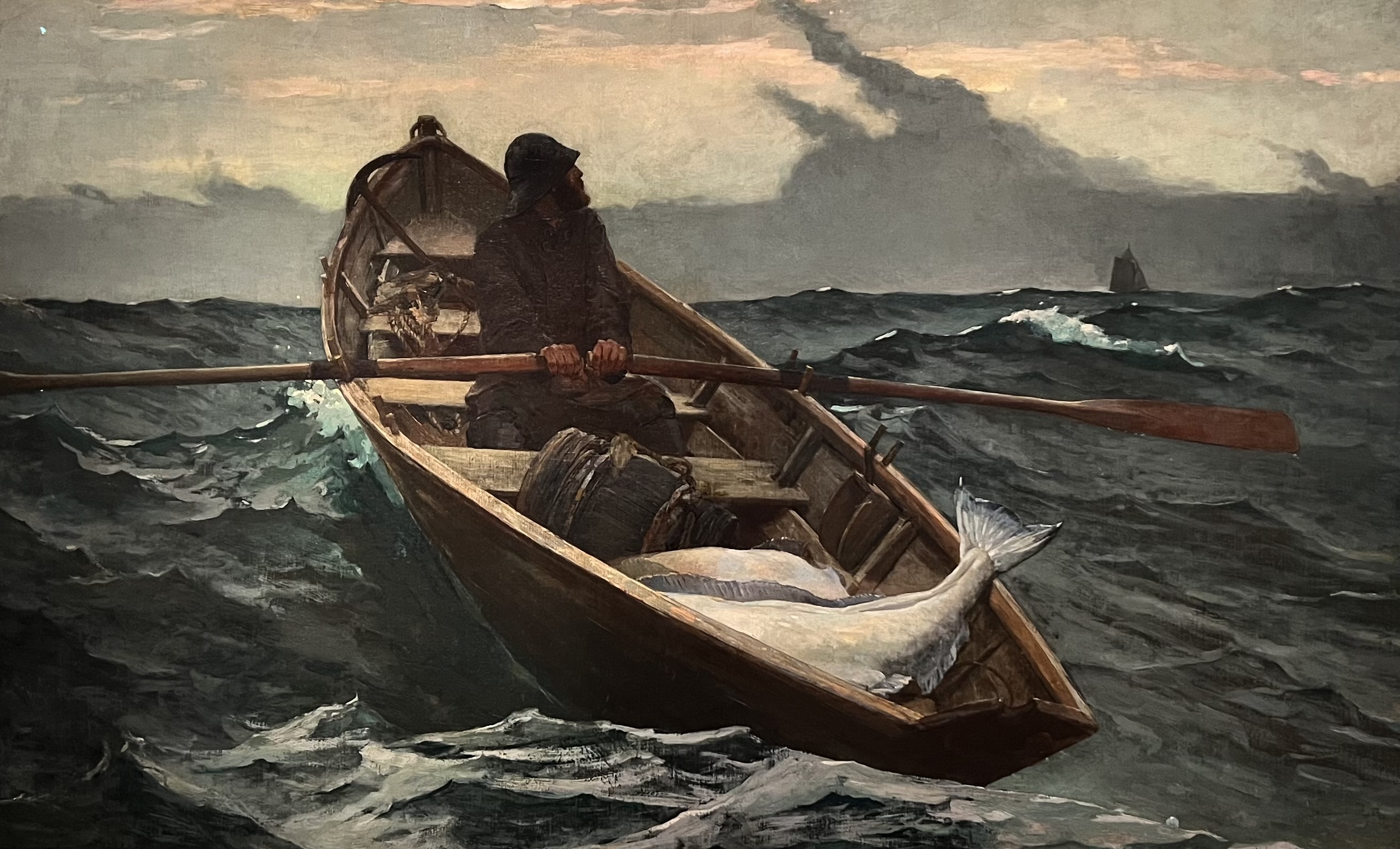
Winslow Homer, The Fog Warning (Halibut Fishing), 1885
Homer often represented the arduous labor of North Atlantic fishermen, based on this experiences at Cullercoats and amplified by observations made around his home on the coast of Maine. In one series of paintings, he explored the inherent dangers of fishing in the Grand Banks, the rich waters southeast of Newfoundland. The meeting of these currents provides a fertile environment for fish, but it also makes the area one of the foggiest places on earth. This painting is infused with tensions as the solo fisherman gazes toward the safety of the distant schooner and considers his ability to reach it before the fog, looming on the horizon, settles.
Winslow Homer, Oranges on a Branch, 1885
Many of Homer’s images of the Bahamas evoke the idea of the islands as a paradise created especially for tourists. Enjoying local fruits was perceived as a fundamental luxury of the visitor experience. This vibrant watercolor, a rare still life by the artist, offers a complete sensory experiance–ripe citrus, bright green leaves, and fragrant blossoms are bathed in warm sunlight.
Winslow Homer, Hurricane, Bahamas, 1898
Homer’s attention to inclement weather in this watercolor distinguishes it from the more idyllic tropical images he produced during a previous trip to Bahamas, in 1884-85. Dark clouds threaten, while several tall palms are lashed by violent winds. This detail combined with the tempestuous weather may evoke the geopolitical turmoil elsewhere in the Caribbean that year, specifically in Cuba and Puerto Rico. The weather events depicted here and in Homer’s images of storms off the coast of Maine represent important precursors to the turbulence of The Gulf Stream.
Winslow Homer, The Gulf Stream, 1899
In Homer’s epic saga set along the Gulf Stream, a Black man faces his possible demise on the deck of a distressed boat, while threatened by sharks and a watersprout. This painting is the culminating expression of various deeply personal and universal themes that Homer explored across his career, particularly the conflict between humans and the natural environment. The Gulf Stream is also rich with geopolitical implications. Homer acknowledged the expanded imperial ambitions of the United States beyond North America with the addition of key elements. Sprayed across the ship’s deck are stalks of sugarcane–the Carribean commodity central to the economy of empire and directly linked to the swift ocean current of the title, which enabled its trade, and the devastating history of transatlantic slavery. Homer interweaves these complicated narratives in a painting that confronts human struggle, personified by a stoic survivor, against the relentless power of nature.
Appendix: 19th and Early 20th Century European Paintings
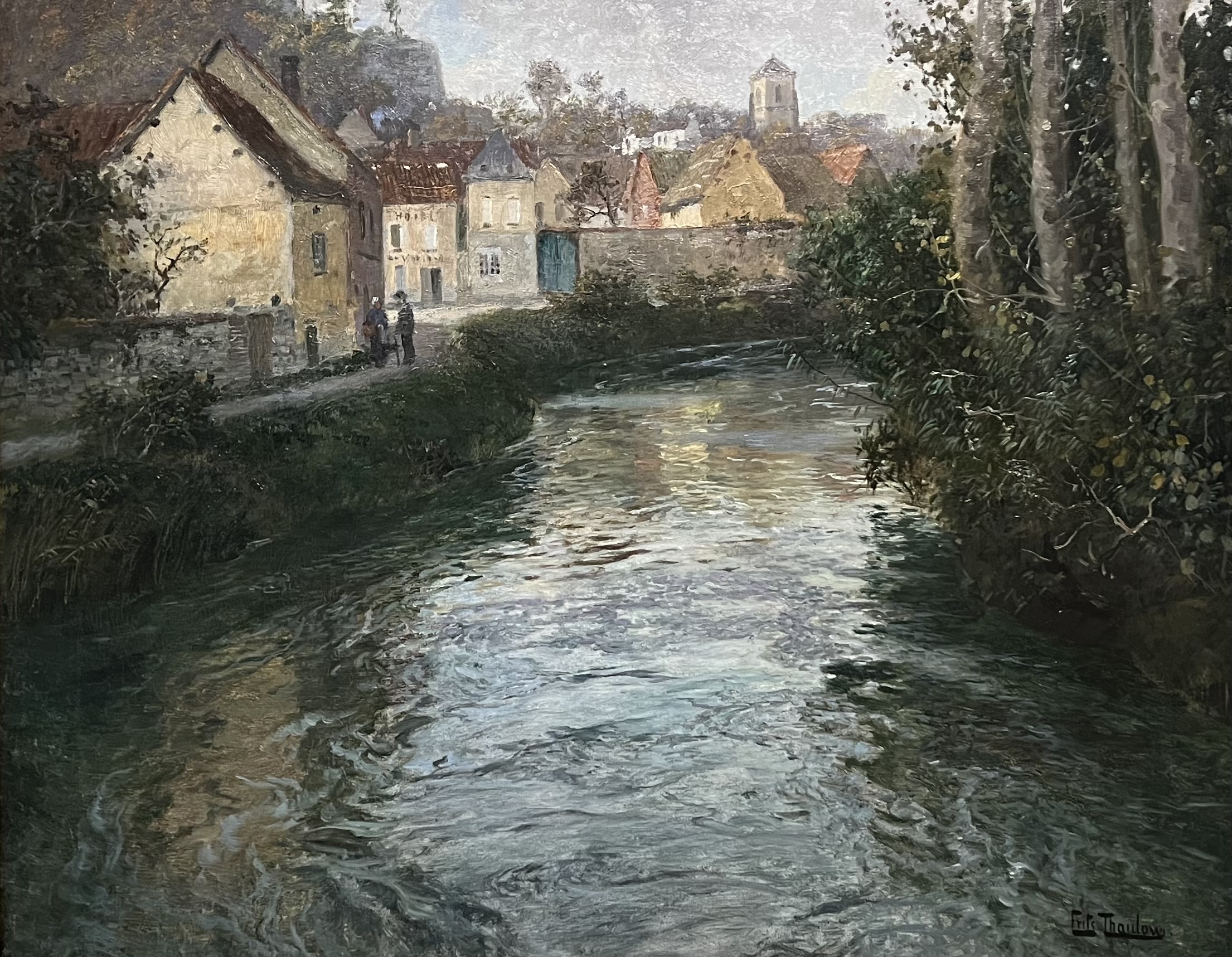
Frits Thaulow, Picquigny, 1899
Thaulow (Norwegian, 1847-1906) earned great success with his depictions of the rivers and byways of Northern France. This canvas shows the village of Picquigny, near Amiens on the river Somme, where the Norwegian painter worked for several weeks in the late autumn of 1899. The composition adopts a downward vantage point that emphasizes the eddying water and its ever-changing colors, reflections and illumination.
Edouard Manet, Madame Manet at Bellevue, 1880
Despite the seemingly rapid brushwork and the summary treatment of detail, this painting was preceded by at least two drawings and an oil sketch. This is Manet’s last portrait of his wife; it was painted at Bellevue, a suburb of Paris, where they spent the summer of 1880.
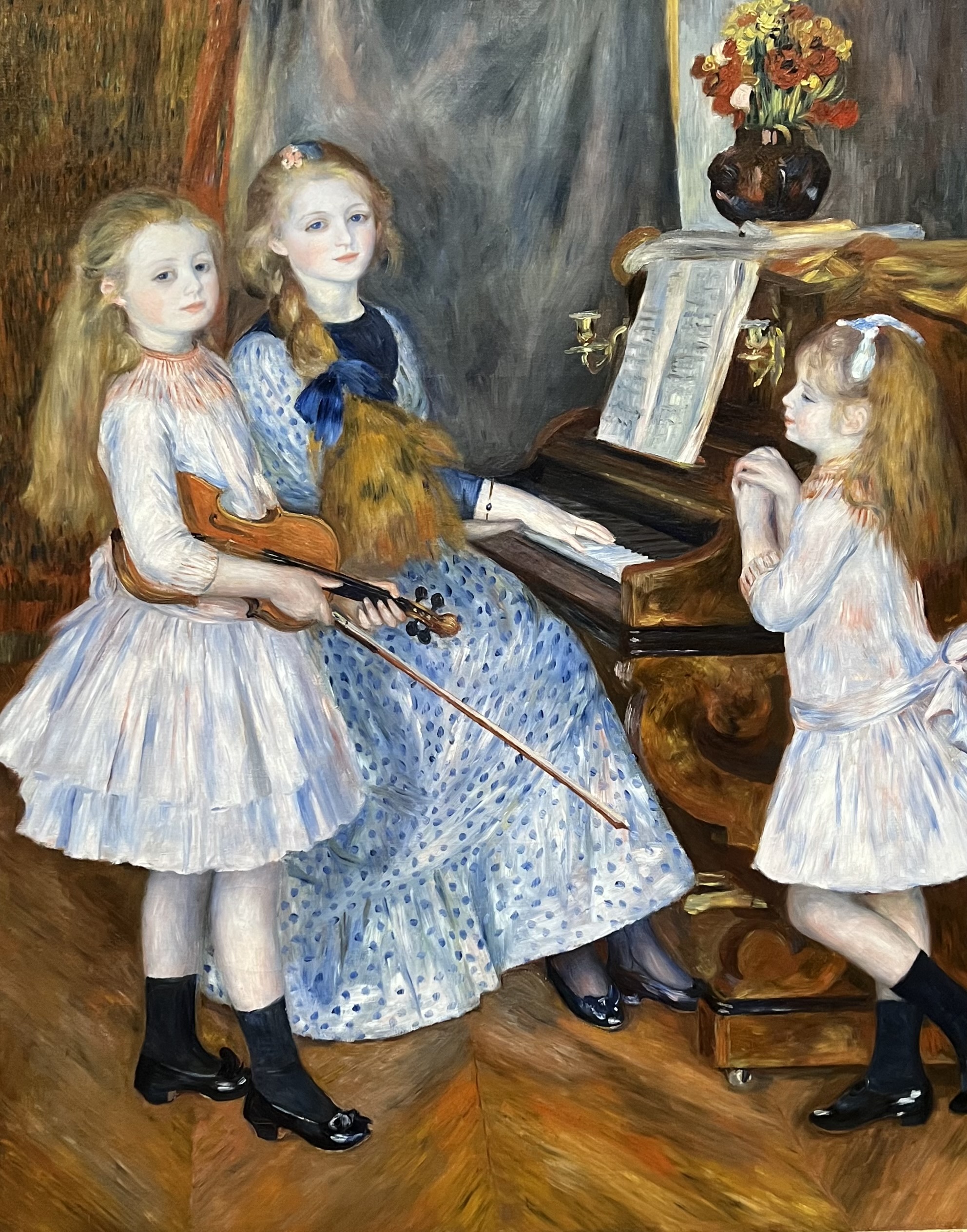
Auguste Renoir, The Daughters of Catulle Mendes, Huguette, Claudine, and Helyonne, 1888
In addition to the girls’ manifest charm, Renoir undoubtedly counted on the notoriety of Mendes’ bohemian parents to gain attention: their father was a Symbolist poet and publisher, and their mother was the virtuoso pianist Augusta Holmes. Renoir completed the commission in a matter of weeks and immediately exhibited the large canvas in May 1888, but the response to his new manner of painting, with its intense hues and schematized faces, was unenthusiastic.
All pictures were taken by the author during his visit to The Art Institute of Chicago. Texts sourced from exhibit label scripts and museum audio guide.
Original draft as of September 7, 2019.
Édouard Manet, Boating, 1874-75
Manet painted Boating in 1874, the same year the Impressionists organized their first exhibition. Unlike many Impressionist works, Boating was not painted outdoors to capture a fleeting moment; Manet actually reworked significant sections in his studio.
Édouard Manet, The Café-Concert, 1878-79
Manet packed this slice-of-life scene to the point of confusion, layering customers, the waitstaff, and a performer’s reflection within the limited frame. The barmaid is drinking beer and the idea that she is taking time away from her job and patrons seems incredibly modern. Manet very likely made quick sketches on the spot and reworked it back in his studio, as a result of a more calculated method. With this Manet announced himself in a strong way at the Vie Moderne gallery in 1880 as a painter of modern life.
Édouard Manet, Still Life with Oysters and Champagne, 1876-78
This exuberant still life features a plate of oysters, a bottle of champagne, and their various accessories. The subject (especially the Japanese fan) and daringly cropped composition, and fluid paint handling signal Manet’s fashionable modernity.
Édouard Manet, Nude Arranging Her Hair, 1878-79
This picture of a woman fixing her hair speaks to Manet’s interest in the activities and accouterments of women’s grooming and styling. Unfinished and unsigned, it was purchased by Berthe Marisot after Manet’s death.
Édouard Manet, Portrait of Madame Manet in the Conservatory, 1876-79
Manet’s sympathetic portrayal of his wife Suzzanne. However, the surface of the painting is strikingly different from contemporaneous depictions of chic young Parisiennes. Like all of Manet’s late portrait of Suzzanne, the painting remained a private work, was retained by the artist’s widow until financial circumstances forced her to sell it.
Édouard Manet, In the Conservatory, 1877-79
In the Conservatory presents a richly ambiguous scene: the two figures’ left hands almost touch. It also remains unclear whether Manet painted the couple in an actual conservatory or created a semblance of one expressly for this and other paintings of this period. This painting was exhibited with Boating at the 1879 Salon, where the two formed a modern pair.
While this painting presents slushy environment and all elements of romance and flirtations, you find it suggests something else, not caring, and indifference. The end result is so narrative but at the same time unyielding in its narrative. Although this painting did not give Manet the universal praise when exhibited in 1879, it becomes foundational for a lot of his later works.
Édouard Manet, Woman Reading, 1880-82
While the mug of beer and the wooden bar attached to the reader’s illustrated journal suggest a Parisian cafe, the scene was in fact composed in Manet’s studio. The backdrop is not a real garden at all, but one of Manet’s own paintings. By 1880, Manet has become less mobile due to illness, and can no longer make it out to the cafes, parks and other Parisian scenes. Instead he resorted to recreating the scenes in his studio.
The woman reading is a modern woman; she has a mug of beer, she is by herself, and she is concentrated in possibly what she is gonna to consume next. Manet said this is the type he would like to show in all his beauty and all of their grace and glamour.
Édouard Manet, The Promenade (Madame Gamby), 1880-81
The model poses in near profile against an artificial verdant backdrop. The composition recalls Manet’s other pictures of fashionable Parisiennes in flowery settings.
Édouard Manet, My Garden (The Bench), 1881
Manet painted this sun-drenched picture in summer 1881. His bright palette and exuberant brushwork create a scene that hardly qualifies as hideous — which is how he described his own garden. Manet is largely confined to the house during this period, discouraged by his illness and frustrated by perpetual bad weather.
Édouard Manet, Still Life with Brioche, 1880
A lighthearted still life. This brings together several of Manet’s favorite motifs. The hat-like egg-washed bread sits askew on a porcelain plat. His wife’s cat, Zizi, emerges from the right edge.
Film Forum’s Introductory Notes (by Roger Ebert) on A Tale of Springtime: Nothing very dramatic usually happens in a Rohmer film, or at least nothing loud and violent. The characters are usually too well-behaved and sometimes too distracted by their own problems to pay much attention to the plot Rohmer has thrust them into. That’s one of the pleasures of a film like this; we can recognize the rhythms of real life, in which personal drama sometimes has to wait while we attend to routine duties. There’s the sense in a Rohmer film that the characters are free to walk out, if they want to; they’re not on assignment to stick with the plot to the bitter end, as they are in a Hollywood film.
2016年,纳瓦尼和索博尔发布了一份关于普京“大厨”普里高津的调查报告,这名俄罗斯商人是普京的亲信,索博尔在报告里罗列了八百多项和他有关联的政府合同。报告发布后一个月,莫科夫在回家路上被不明人士袭击,身上被注射了药物,警方虽然调取了监控录像但结果不了了之。这个意外事件让莫科夫进一步认识到他与索博尔在观念上的分歧,“I realized, once and for all, that there is no justice in Russia and there never will be. Sobol redoubled her efforts to build the wonderful Russia of the future.”
在问到为什么还愿意呆在俄罗斯时,索博尔反问道为什么不,而且她认为就算选择离开,也不能因此获得永久的安宁。“She reeled off a list of assassinations that Russia has allegedly carried out abroad. There is also the risk of retaliation against family members”。与想要坚持战斗下去的索博尔不同,莫科夫觉得这样的生活糟透了,但是除了留在俄罗斯也别无他法。“Emotionally, this is an appalling way to live. I have no private life. Lyuba says I knew what I was getting into when I married her, but I didn’t. I was getting married to a young lawyer, not to an opposition politician.”
马可的老师建议他每周看一次心理咨询师,但每次交流的时候,亨克尔就坐在隔壁的房间,斯文也被建议过同样的事情,但一开始就被亨克尔否决了。后来肯特勒专门致信给当地青少年福利部门,指出如果非要进行心理方面的测试,可以由他本人执行,在信中他还特地为亨克尔开脱,“I ask you to consider that a man who deals with such seriously damaged children is not a ‘simple person’ ”。此外,亨克尔和肯特勒也极力阻止马可定期与他母亲和哥哥的会面,认为这些人为马可的成长树立了一个很不好的榜样,肯特勒写道,“The boy gives the (false) impression of strength and superiority.”
文章进一步追根溯源到德国在二战后对纳粹的反思,国家对性行为的管控某种程度上成为了一种“树立新道德”和赎罪的方式,战后二十年里,对女性生育权利的限制和同性恋的逮捕十分盛行。1960年心理学专业毕业的肯特勒则持不同观点,他认为奥斯维辛悲剧的发生,与德国人从小被教育要抑制自己的性冲动从、成为一个更“伟大”的人的观念有直接关系,他开出的“治病良方”不是进一步的性抑制,而是性解放。在那个年代,性教育的讨论是整个国家反思纳粹的过程中一个重要组成部分,当然也有人指出这本质上是一种逃避,“it was also a way to redirect moral debate away from the problem of complicity in mass murder and toward a narrowed conception of morality as solely concerned with sex.”
在逐渐与自己的家人失去联系以后,马可对自己父母的全部印象都来自亨克尔和肯特勒的描述,直到二十年以后,他才知道其实那段时期自己的生父母也很想与他重修关系,但都被自己的养父拒之门外。亨克尔还变相鼓励马可在学校里捣蛋,现在回想起来自己小时候转了七次学,基本没什么同龄朋友,马可开始意识到这一切可能都是亨克尔的“计划”。马可十八岁的时候,他没有立刻想要从亨克尔家里搬出,“It’s very hard to describe, but I was never raised to think critically about anything.”
肯特勒在自己大部分学术生涯里都认为恋童癖领养者对孤儿的成长是有利的,他认为两者间的性行为只要不是强制发生的就不必担心,对于那些从小失去亲人的孤儿来说,这可能反倒是一种良性的“治疗”。“Kentler’s experiment seemed to rest on the idea that some children are fundamentally second class, their outlook so compromised that any kind of love is a gift”,但在1991年他最小的养子自杀之后,肯特勒开始反思自己的观点。其他学者明确指出,成年人和儿童之间的性关系永远是不平等和带有剥削性质的,表面上恋童癖给予了这些孩子更多的爱(或者至少是一种不一样的爱),但最终的结果只会是对他们应当享有的爱的剥夺。
作者在2020年夏天与马可见面时,在场的还有一名叫克里斯托弗·施韦尔的人,他是德国右翼党派AfD的成员,声称是出于好心想要主动帮助马可。在“肯特勒实验”的调查报告公布之后,马可曾多次联系政府想要了解更多细节但没有得到答复,而在AfD方面看来,马可的例子便是德国左翼政府在性教育上失败的明证,他们还试图将该事件与对同性恋的抨击联系在一起,“History seemed to be looping back on itself. Right-wing politicians were calling for a return to the kind of ‘terribly dangerous upbringing’ against which Kentler had rebelled”。事情发酵之后,左派一方也站出来指出AfD居心不良,社会民主党成员桑德拉·希尔里斯认为解决问题最好的方式是让马可得到经济补偿而不是没完没了的诉讼。
马可自己当然不想成为政治上的工具,他更关心的是自己现在的家庭和未来的生活。在收到了来自政府五万欧元的补偿之后,马可拒绝了克里斯托弗继续上诉的提议,他说,“We have gotten our wishes, so there’s no point in further irritating or tyrannizing the Senate”。马可现在有两个孩子,他在不久前还和妻子艾玛举行了婚礼,虽然只是走过场,但对他来说依然意义重大,“自由不是一夜之间来到的”,他说,“I don’t know how to say it, but it was the first time that I figured out that I am living a life with a billion different possibilities. I could have been anything.”
飞行伴随着的不确定性让“我”经常生活在提心吊胆中,有一次Karl比原计划晚了几个小时到家,其间联系中断,让“我”一度以为他发生了意外。当Karl终于走进家门,“I wanted to kill him because he had not been killed“,他冷静地给“我”叙述了经过,还安慰“我”说,要是真出了意外,应急电台(ELT)会主动联系家属的。还有一次,飞行结束后他异常平静地跟“我”说除了引擎坏掉了之外,一切正常。同一个屋檐下生活的两个人,对生命重量的感知竟如此不同,不过随着时间流逝,“我”渐渐开始习惯。
Karl对待飞行很专注,他迟迟不去考取驾照不是因为没有时间,而是一心想拿满分。他换座驾的时候从不考虑新飞机而是专挑便宜货,因为他觉得从折扣品里挑到物超所值的好货是才是这项爱好的最大乐趣。相处久了,“我”逐渐放下起初的敏感和担惊受怕,开始清楚意识到这个男人身上的勇敢和冒险精神才是自己真正想要的,而且有了飞行,“我”就有更多时间和Karl在一起。有很长一段时间Karl戒掉了飞行,后来重新拾回爱好后“我们”两人都十分开心,他自然是因为能够回到驾驶舱,“…and I was happy because we were together in the plane. I understood that I had no influence on the safety of the flight, but I was with him, and when I was with him I didn’t worry about it. If something happened, it would happen to both of us.”
那次从密西西比母亲家飞回纳什维尔的旅程让“我”终身难忘,原因是“我”竟然莫名其妙地在起飞之前忘了关舱门,当然在Karl的冷静操作下“我们”最终安然无恙。“我”一度以为因为自己的疏忽会赔上两条命,Karl则不以为然地解释道这根本不会发生。在“我们”降落后从机场开车回家的路上,他甚至兴致勃勃地开始给“我”讲述伯努利原理,解释为什么门因为气压关系会一直开着,“我”一个字都听不进去。“I understood none of it. What I understood was that there was no keeping anyone safe–one person remembers to tip the nose up for the landing, while the other person forgets to latch the door, and , in the end, it probably won’t be the nose tip or the door. It won’t be the nose tip or the door. It will be something infinitely more mundane. It will be life and time, the things that come for us all.”
关于性别差异对棋艺水平影响的讨论从未停止过,很多人认为,男女大脑之间的差异确实对下棋有影响,前者更有能力保持长时间专注和在极端情况下思考,但是也有研究表明,男女性别内部的个体差异足以抵消性别差异带来的影响,而且后天训练和经验的作用也不能忽视。和女选手对话之后作者发现,她们中很多人对这个领域里男性的天生优势持默认态度,侯逸凡被问及这个问题时虽然没有直接肯定,但也指出对男孩女孩教育方法上的差异是一大因素,“Most girls are told at an early age that there’s a kind of gender distinction, and they should just try their best in the girls’ section and be happy with that.”
世界排名第一的芒努斯·卡尔森在小时候和姐姐一起学棋,起初芒努斯对国际象棋一点都不感兴趣,反倒是姐姐一开始学得很快。但是他们的父亲回忆道,芒努斯的特别之处在于可以专注做一件事很长时间,他在四岁的时候可以一连坐着六个小时拼乐高,而姐姐艾伦则经常把兴趣点移至别处。艾伦一度也是一名出色的俱乐部选手,但最终决定退出,“…she tired of the attention that came with being one of the few women in chess, …It made her anxious, she said, to see the best players in a hall gathered around her board, studying her moves”,外界对优秀女选手投来的目光反倒成为她们继续前进的阻力。
和以往投身专业道路的女选手不同,侯逸凡在拿到世界冠军后决定继续在大学深造,尽管她深知如果想要继续进步(比如达到世界前二十的水平),放弃学业是唯一的一条路。前世界冠军波尔加也同样认为,在顶尖比赛上很少看见女选手并不是因为女孩子比男孩子差,而是她们到头来没有那么多时间。侯逸凡看得很开,她既没有把国际象棋看作是自己生命中的唯一,也认为下棋和参加比赛并不是她参与的唯一方式。“There is something to be said of using chess to enrich one’s life instead of using one’s life to master chess”,而且,”Addressing the gender disparity at the top comes from addressing the disparity at the bottom”,通过自身的努力让更多女孩子接触并喜欢上国际象棋,在她看来同样十分有意义。
The Diversity Verdict, by Nicholas Lemann
本文详细梳理了黑人平权运动在大学录取层面的历史和近况。上世纪三四十年代的哈佛校长科南特通过推出标准化测试,试图将不同背景的学生拉回同一起跑线,“But Conant was mistaken in believing that he could use the SAT as a way to create a classless society”,黑人学者和人类学家埃利森·戴维斯就强烈反对这一政策,他认为SAT考试是对中上层阶级家庭孩子教育资源丰富“科学化”的认可,标准化分数的使用,把本就处在社会底层的黑人学生进一步定义为在科学公平的机会面前表现相对逊色的那一群人,“…standard tests complicated their commitments. Testing made it possible to create a numerical ranking of all applicants…”
一直以来,多样性在很多人眼中是黑人平权运动的法理基础,通过政策让更多的黑人学生加入大学校园,丰富学生群体的多样性,在人们看来是有必要去做的事情。但也有人同时认为,如果仅从多样性的角度去看待这件事情,“[it] appears to regard greater numbers of Black students on campus primarily a way to broaden the experience of white students, and it fails to recognize the historical debt the country owes to Black people”,与此同时,过度强调多样性也会让人们忽略其他关键因素,比如融入(integration)。某种程度上,录取更多黑人学生之所以成为各大学乐意去做的事情,正因为它的可操作性而不是别的,在完成了多样性这个”指标“之后,他们有充足的理由把解决种族不平等的问题转嫁给他人。
– Every place, even if it’s not at all glamorous, has its own secrets and seductions. The most glamorous places may be the least secretive, the most blank.
– She took a sharp interest in current affairs and insisted on watching the news, although she did get muddled about the facts; even when she was younger she hadn’t been all that strong on facts.
– You may be thinking that I was pretty self-sacrificing, giving up my own life to come down to the seaside during lockdown to look after my aging mother, to sort out her bills and her mail, cook her meals, sit with her every evening in front of the telly turned up very loud with the subtitles on. But the fact was that at that point my own life wasn’t much to write home about.
– When a man was unfaithful, the disgrace of it was somehow with the woman who’d failed to hang on to him.
– I remember from my time at school how little it took to set a day apart, surround it with happiness; perhaps one of the girls I worshipped gave me a biscuit left over from her break, or asked if she could copy my Latin homework. It was only later, when I transferred my worship to men, that everything grew complicated.
New Horizons IFF’s Introductory Notes on Bad Luck Banging or Loony Porn: The provocative, brilliant, angry and irresistibly funny film by Radu Jude deals with the phenomenon of moral panic, exposing the accompanying hypocrisy, ignorance and authoritarian tendencies. What is “really” obscene here: the sight of people having sex with mutual consent and to their mutual satisfaction, or perhaps the poverty depicted here of a city devastated by wild capitalism and nationalist ideology? Who is perverse, the teacher or the self-proclaimed tribunal of staunchly indignant parents that has gathered at school to judge her? Filled with archival materials, Bad Luck… is a catalog of the true variants of pornography, whether political, religious, or class, shamelessly spreading under noble slogans. The real reasons for shame, Jude argues, can be found on our streets and in our own history books. (Małgorzata Sadowska)
New Horizons IFF’s Introductory Notes on Wheel of Fortune and Fantasy: Rohmerian in spirit, but bearing the expressive mark of Ryûsuke Hamaguchi’s style, Wheel of Fortune and Fantasy, consists of three short stories, each revolving around the theme of chance. …it is also a journey towards a growing feeling of uncanniness, because the film, which starts out like a classic morality tale, slowly moves towards fantasy, where a twist of fate takes on extraordinary features. …the scenes, shot mainly in interiors two actors each are phenomenal, nuanced portraits of relationships. Brilliant observations and a discreet sense of humor are accompanied by a sadness that makes Hamaguchi’s film a quiet sigh over wasted opportunities and our imperfection. (Małgorzata Sadowska)
New Horizons IFF’s Introductory Notes on The Girl and the Spider:An intricate web of hidden longing and veiled emotions is woven over the course of two days and one night when Lisa abandons her roommates and moves to her own apartment. The energy triggered by moving …puts everyone in a state of tension that travels like a cold sore from Lisa’s mouth to Mary’s. …Set almost entirely indoors, the film is structured like the eponymous spider’s web with perfect though fragile geometry. And the layouts of the new and old apartments can serve as maps used to decipher their tenants’ inner lives. Like a prism, they capture the things that people do when they think no one is watching. The viewers are also constantly surprised with dynamic, unexpected changes in viewpoints that clue the audience into secret details noticed by no one – save for the spider in the corner of the room.
New Horizons IFF’s Introductory Notes on What Do We See When We Look at the Sky: The sun lights up the streets, the soccer world championship is approaching, children chase footballs, street urchins wander to their favorite pubs, the leaves of lush trees rustle, and the foaming river whispers. Although What Do We See When We Look At the Sky comes close to the convention of magical realism, it ultimately eludes simple classifications. It is full of panache, but also tenderness, contemplation of what constitutes a specific, everyday reality, pulsating with life. The director meanders, releases the narrative, digresses only to return to the main plot. He focuses not so much on the events as on their images, always visually mesmerizing. It is a fairy tale film, but also a tribute to “filmmaking.” (Karolina Kosińska)
New Horizons IFF’s Introductory Notes on Stop-Zemlia: We meet the sensitive Masha who is part of a group of friends along with Yana and Senia. They experiment together, struggle with loneliness, problems with their parents, and first loves. …In her impressive debut, Ukrainian director Kataryna Gronostai, with warmth and sensitivity captures the moment in life when pain intertwines with hope and everything is so easy and so difficult at the same time. An authentic, almost documentary portrait of contemporary youth, who brought their experiences and language to the film during workshops preceding the shooting, combine here with a poetic touch. (Adam Kruk)
New Horizons IFF’s Introductory Notes on Wood and Water: The prolonged absence forces the woman to take lonely walks around the city, which turn into a series of random meetings, conversations and fascinations. Jonas Bak blurs the lines between documentary and fiction; although he tells a fictional story, the film stars his mother, sisters and friends. The shooting coincided with Hong Kong’s groundswell of protests against the extradition bill, though politics take a back seat to Bak’s main vision. More important here is Anke’s inner journey: her transformation, which unfolds slowly, timidly, but ultimately allows her to open up to other people and start a new phase of life. (Jakub Demiańczuk)
New Horizons IFF’s Introductory Notes on Luzzu: The film’s title is taken from the traditional Maltese coastal fishing boat. One of the local captains, Jesmark, continues his family fishing tradition, but is struggling with ever stronger competition. …Camilleri focuses attention on Jesmark’s drama, drawing a broader social and political background at the same time. The blame for the deteriorating fate of Maltese fishermen is not only on the black market, but also stringent EU legislation, progressive environmental degradation and the incipient climate catastrophe. Most of all, however, Luzzu is an emotional portrait of a man whose stable life begins to fall apart overnight. (Jakub Demiańczuk)
Melbourne International Film Festival’s Introductory Notes on El Planeta: El Planeta is the wittily droll feature debut of New York–based Argentinian artist Amalia Ulman, …Here, she once again blurs fantasy and reality, starring opposite her actual mother, Ale Ulman, in a semi-autobiographical story of economic hardship that is also inspired by an infamous real-world mother–daughter pair of con artists. Charmingly loose and informal, this film paints a playful and disarming picture of life on the edges.
New Horizons IFF’s Introductory Notes on Death of a Virgin, and the Sin of Not Living: Excited, gilded by the afternoon sunlight, the boys step boldly, as if the world belonged to them. They don’t yet know that they belong to the world: it directs their path and the shape of their masculinity, prompts them with dialogues, and directs disappointing, humiliating rituals of passage. …Brought up in a patriarchal culture, young men have – against bold plans – limited opportunities, and the foundations of their power have long been rotten. Delicate beneath a chatty, cheerful surface, the debut of Lebanese director George Peter Barbari, successfully combines realism with poetry, and the gentle movements of the camera embrace the heroes in a gesture they would never have made themselves. (Małgorzata Sadowska)
Melbourne International Film Festival’s Introductory Notes on Bad Luck Banging or Loony Porn: Winner of the prestigious Golden Bear at the 2021 Berlinale, this comic, determinedly offbeat provocation by eclectic Romanian New Wave auteur Radu Jude takes aim at everything from sexist double standards to Romania’s political system to cinema itself. Polemical and unashamedly audacious, Bad Luck Banging or Loony Porn throws cinema vérité, surreal satire and essay film into a blender to confront a world in which everyone is seemingly willing to cast the first stone.
Melbourne International Film Festival’s Introductory Notes on What Do We See When We Look at the Sky?: As he follows the couple’s journey towards reunification, writer/director Alexandre Koberidze also takes viewers on a leisurely and wittily self-aware detour through daily life in the historic Georgian city of Kutaisi, whose human, canine and inanimate-object populations are in the grip of World Cup fever. Saturated in colour thanks to Faraz Fesharaki’s artful mix of 16mm and digital cinematography, What Do We See When We Look at the Sky? is an expansive, eloquent love letter to romance, to the mundane and the magical, and to the art of cinema itself.
Melbourne International Film Festival’s Introductory Notes on Wheel of Fortune and Fantasy: Once again foregrounding his female characters, the Japanese auteur weaves his vignettes so that they interconnect in odd, gently unpredictable ways, twisting and turning around chance connections, mirrored selves and unlikely romantic portals – as the director himself puts it, they are tales of “coincidence and imagination”. Wheel of Fortune and Fantasy is another ingenious exploration of modern love from a filmmaker fast becoming a contemporary master of the terrain.
Melbourne International Film Festival’s Introductory Notes on The Girl and the Spider: The second film in Ramon and Silvan Zürcher’s loose trilogy about human togetherness follows their award-winning feature debut, The Strange Little Cat, in building a lingering claustrophobic tension hemmed in by four walls. As extended family members, neighbours, handymen and hangers-on pass in and out of the two flats, a palpable undercurrent of sexual desire and jealously fills the frame, and an increasingly chaotic whirl of ambiguity – underscored by Eugen Doga’s Gramofon waltz – threatens to tear it all apart. As a cinematic madrigal on the nature of impermanence, The Girl and the Spider is a unique work of taut, existential distinction.
Melbourne International Film Festival’s Introductory Notes on Drive My Car: Based on the eponymous short story by Haruki Murakami, Hamaguchi’s Cannes Best Screenplay winner is a poignant, moody triumph that channels his previous films with its intimate focus on a slowly unfolding, ultimately reparative relationship between two seemingly mismatched people. Warm and observant, with a memorably vivid visual style that evokes Wong Kar-wai and a powerfully contained performance by Hidetoshi Nishijima as Yūsuke, Drive My Car is another unique and stunning drama from one of Japan’s master storytellers of modern relationships.
LONDON, ENGLAND – JULY 06: Sergio Busquets of Spain in possession during the UEFA Euro 2020 Championship Semi-final match between Italy and Spain at Wembley Stadium on July 06, 2021 in London, England. (Photo by Laurence Griffiths/Getty Images)LONDON, ENGLAND – JULY 06: Federico Chiesa of Italy celebrates with Nicolo Barella after scoring their side’s first goal during the UEFA Euro 2020 Championship Semi-final match between Italy and Spain at Wembley Stadium on July 06, 2021 in London, England. (Photo by Frank Augstein – Pool/Getty Images)
LONDON, ENGLAND – JULY 07: Kyle Walker of England battles for possession with Joakim Maehle of Denmark during the UEFA Euro 2020 Championship Semi-final match between England and Denmark at Wembley Stadium on July 07, 2021 in London, England. (Photo by Shaun Botterill – UEFA/UEFA via Getty Images)England’s forward Harry Kane (top L) vies with Denmark’s defender Jannik Vestergaard (top R) during the UEFA EURO 2020 semi-final football match between England and Denmark at Wembley Stadium in London on July 7, 2021. (Photo by Laurence Griffiths / POOL / AFP) (Photo by LAURENCE GRIFFITHS/POOL/AFP via Getty Images)
SAINT PETERSBURG, RUSSIA – JULY 02: Gerard Moreno of Spain battles for possession with Ricardo Rodriguez of Switzerland during the UEFA Euro 2020 Championship Quarter-final match between Switzerland and Spain at Saint Petersburg Stadium on July 02, 2021 in Saint Petersburg, Russia. (Photo by Anatoly Maltsev – Pool/Getty Images)
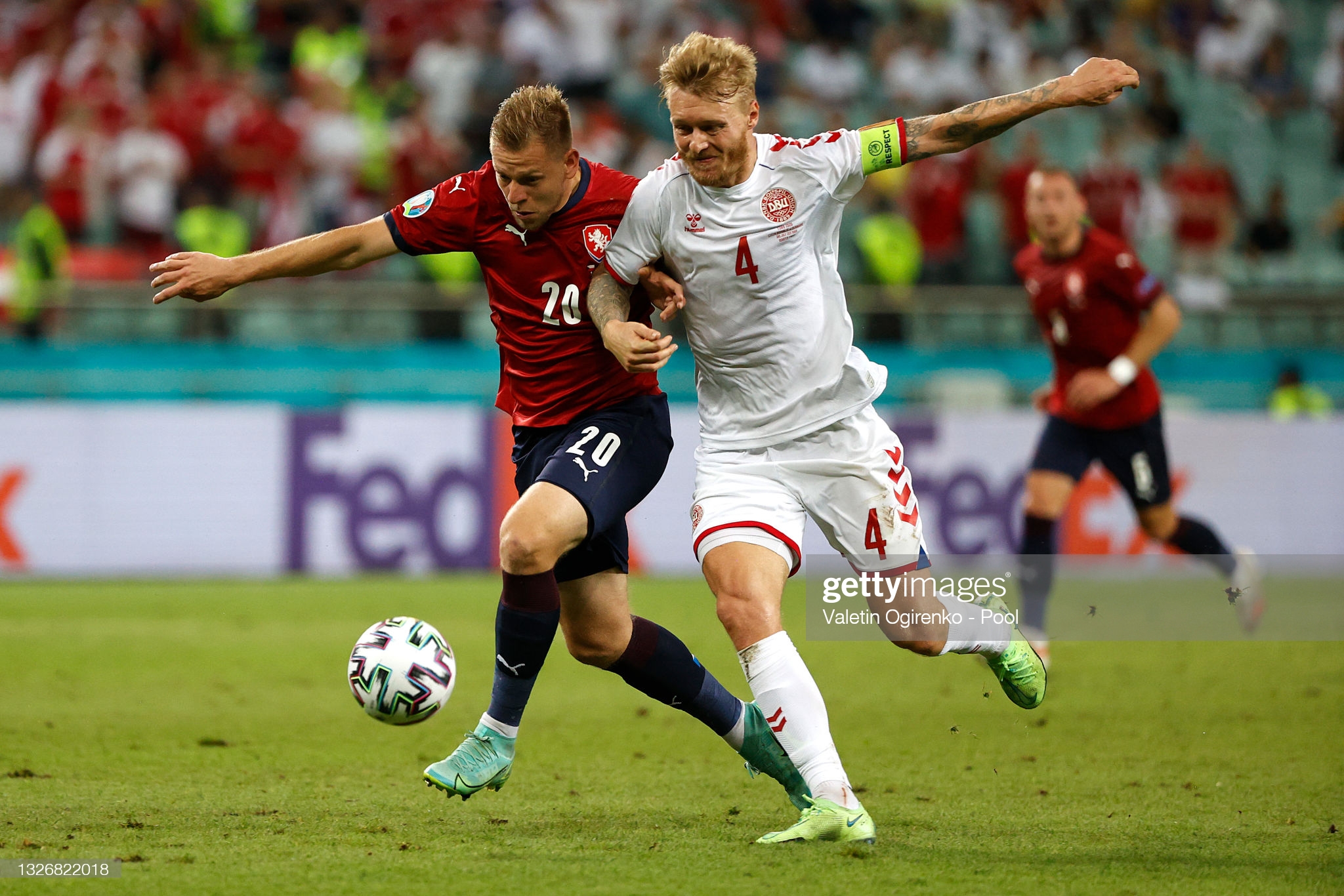
BAKU, AZERBAIJAN – JULY 03: Matej Vydra of Czech Republic battles for possession with Simon Kjaer of Denmark during the UEFA Euro 2020 Championship Quarter-final match between Czech Republic and Denmark at Baku Olimpiya Stadionu on July 03, 2021 in Baku, Azerbaijan. (Photo by Valetin Ogirenko – Pool/Getty Images)
ROME, ITALY – JULY 03: Declan Rice of England battles for possession with Mykola Shaparenko of Ukraine during the UEFA Euro 2020 Championship Quarter-final match between Ukraine and England at Olimpico Stadium on July 03, 2021 in Rome, Italy. (Photo by Chris Ricco – UEFA/UEFA via Getty Images)
MUNICH, GERMANY – JULY 02: Jorginho of Italy gestures during the UEFA Euro 2020 Championship Quarter-final match between Belgium and Italy at Football Arena Munich on July 02, 2021 in Munich, Germany. (Photo by Claudio Villa/Getty Images)
Austria’s defender Stefan Lainer (L) and Italy’s defender Leonardo Spinazzola (R) vie for the ball during the UEFA EURO 2020 round of 16 football match between Italy and Austria at Wembley Stadium in London on June 26, 2021. (Photo by Ben STANSALL / POOL / AFP) (Photo by BEN STANSALL/POOL/AFP via Getty Images)
BUDAPEST, HUNGARY – JUNE 27: (L-R) Antonin Barak of Czech Republic, Daley Blind of Holland during the EURO match between Holland v Czech Republic at the Puskas Arena on June 27, 2021 in Budapest Hungary (Photo by Eric Verhoeven/Soccrates/Getty Images)
Portugal’s forward Cristiano Ronaldo (L) vies with Belgium’s defender Thomas Vermaelen during the UEFA EURO 2020 round of 16 football match between Belgium and Portugal at La Cartuja Stadium in Seville on June 27, 2021. (Photo by Julio Munoz / POOL / AFP) (Photo by JULIO MUNOZ/POOL/AFP via Getty Images)
Switzerland’s forward Haris Seferovic (R) heads the ball to score the first goal during the UEFA EURO 2020 round of 16 football match between France and Switzerland at the National Arena in Bucharest on June 28, 2021. (Photo by FRANCK FIFE / POOL / AFP) (Photo by FRANCK FIFE/POOL/AFP via Getty Images)
COPENHAGEN, DENMARK – JUNE 28: Cesar Azpilicueta of Spain celebrates after scoring their side’s second goal during the UEFA Euro 2020 Championship Round of 16 match between Croatia and Spain at Parken Stadium on June 28, 2021 in Copenhagen, Denmark. (Photo by Martin Rose – UEFA/UEFA via Getty Images)
LONDON, ENGLAND – JUNE 29: Raheem Sterling of England celebrates after scoring their side’s first goal during the UEFA Euro 2020 Championship Round of 16 match between England and Germany at Wembley Stadium on June 29, 2021 in London, England. (Photo by Catherine Ivill/Getty Images)
BAKU, AZERBAIJAN – JUNE 20: Granit Xhaka of Switzerland is challenged by Cengiz Under of Turkey during the UEFA Euro 2020 Championship Group A match between Switzerland and Turkey at Baku Olimpiya Stadionu on June 20, 2021 in Baku, Azerbaijan. (Photo by Ozan Kose – Pool/Getty Images)
BUCHAREST, ROMANIA – JUNE 21: Florian Grillitsch of Austria battles for possession with Oleksandr Zinchenko of Ukraine during the UEFA Euro 2020 Championship Group C match between Ukraine and Austria at National Arena on June 21, 2021 in Bucharest, Romania. (Photo by Alex Caparros – UEFA/UEFA via Getty Images)
COPENHAGEN, DENMARK – JUNE 21: Jannik Vestergaard, Andreas Christensen and Simon Kjaer of Denmark protest to Match Referee, Clement Turpin after a penalty is awarded for Russia during the UEFA Euro 2020 Championship Group B match between Russia and Denmark at Parken Stadium on June 21, 2021 in Copenhagen, Denmark. (Photo by Wolfgang Rattay – Pool/Getty Images)
LONDON, ENGLAND – JUNE 22: Bukayo Saka of England runs with the ball whilst under pressure from Tomas Holes of Czech Republic during the UEFA Euro 2020 Championship Group D match between Czech Republic and England at Wembley Stadium on June 22, 2021 in London, England. (Photo by Laurence Griffiths/Getty Images)
GLASGOW, SCOTLAND – JUNE 22: John McGinn of Scotland battles with Marcelo Brozovic of Croatia during the UEFA Euro 2020 Championship Group D match between Croatia and Scotland at Hampden Park on June 22, 2021 in Glasgow, Scotland. (Photo by Jan Kruger – UEFA/UEFA via Getty Images)
BUDAPEST, HUNGARY – JUNE 23: Karim Benzema of France scores their side’s first goal from the penalty spot during the UEFA Euro 2020 Championship Group F match between Portugal and France at Puskas Arena on June 23, 2021 in Budapest, Hungary. (Photo by Franck Fife – Pool/Getty Images)
MUNICH, GERMANY – JUNE 23: Leon Goretzka of Germany celebrates 2-2 with Kevin Volland of Germany during the match between Germany v Hungary at the Allianz Arena on June 23, 2021 in Munich Germany (Photo by Laurens Lindhout/Soccrates/Getty Images)
ROME, ITALY – JUNE 16: Manuel Locatelli of Italy celebrates after scoring their side’s second goal during the UEFA Euro 2020 Championship Group A match between Italy and Switzerland at Olimpico Stadium on June 16, 2021 in Rome, Italy. (Photo by Alberto Lingria – Pool/Getty Images)
AMSTERDAM, NETHERLANDS – JUNE 17: (L-R) Matthijs de Ligt of Holland, Georginio Wijnaldum of Holland, Konrad Laimer of Austria during the EURO match between Holland v Austria at the Johan Cruijff Arena on June 17, 2021 in Amsterdam Netherlands (Photo by Eric Verhoeven/Soccrates/Getty Images)
TOPSHOT – Denmark’s defender Andreas Christensen (L) and Belgium’s midfielder Kevin De Bruyne vie for the ball during the UEFA EURO 2020 Group B football match between Denmark and Belgium at the Parken Stadium in Copenhagen on June 17, 2021. (Photo by STUART FRANKLIN / POOL / AFP) (Photo by STUART FRANKLIN/POOL/AFP via Getty Images)
LONDON, ENGLAND – JUNE 18: Grant Hanley of Scotland competes for a header with Marcus Rashford of England during the UEFA Euro 2020 Championship Group D match between England and Scotland at Wembley Stadium on June 18, 2021 in London, England. (Photo by Shaun Botterill – UEFA/UEFA via Getty Images)
MUNICH, GERMANY – JUNE 19: Thomas Mueller of Germany celebrates their side’s third goal scored by team mates Kai Havertz (not pictured) during the UEFA Euro 2020 Championship Group F match between Portugal and Germany at Football Arena Munich on June 19, 2021 in Munich, Germany. (Photo by Alexander Hassenstein/Getty Images)